

EIN Requirements in Georgia
The EIN requirement for Georgia businesses is a function of federal law, not Georgia state law, but the practical context of operating in Georgia shapes how and when the requirement applies. Understanding what triggers the EIN requirement, what the application process involves, and how the EIN connects to Georgia-specific compliance obligations gives business owners a clearer picture of what is actually required.
The Federal Framework
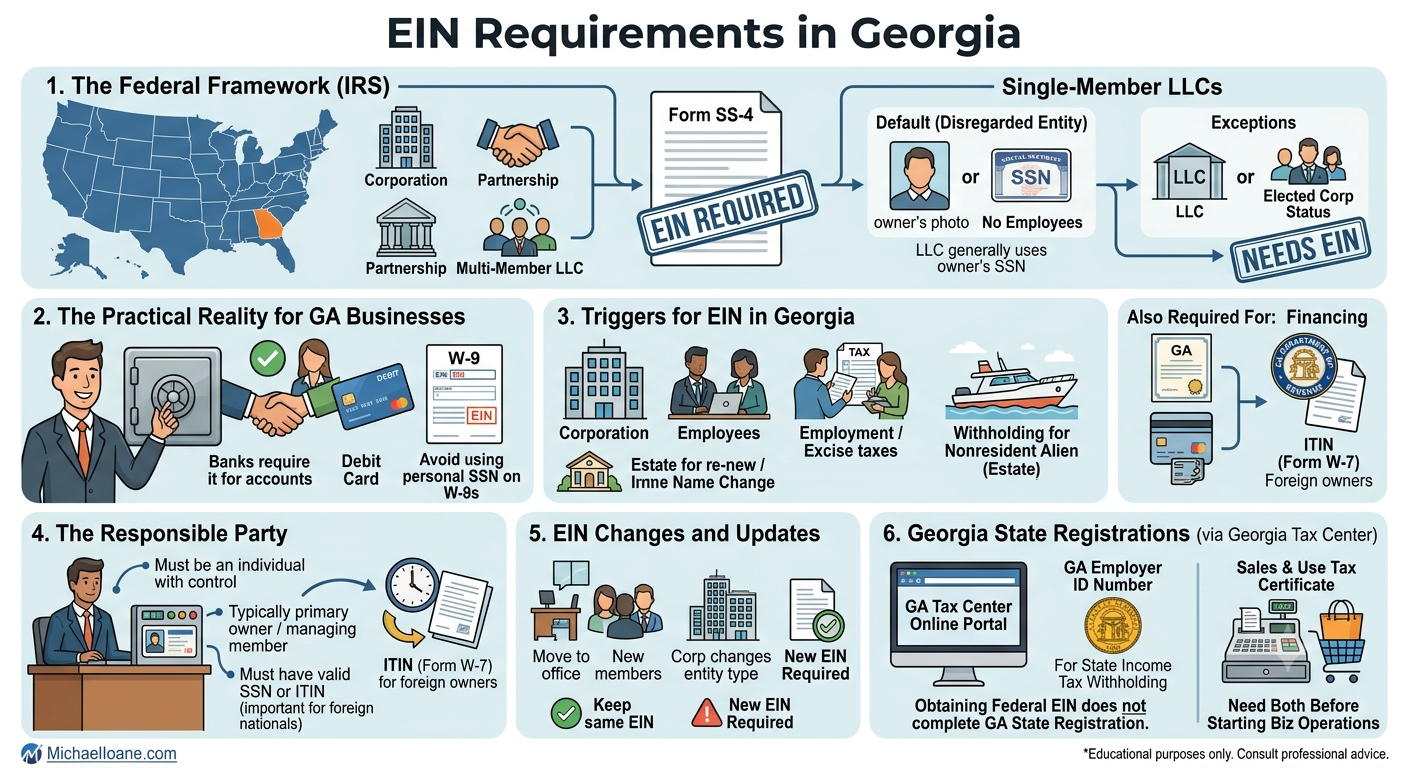
The EIN is a federal tax identifier issued by the IRS under the authority of the Internal Revenue Code. Every business entity that is recognized as a separate taxpayer for federal purposes needs its own EIN. That includes corporations, partnerships, and multi-member LLCs, all of which are separate taxpayers regardless of their size or activity level.
Single-member LLCs occupy a somewhat different position. The default federal tax treatment for a single-member LLC is disregarded entity status, meaning the IRS treats the LLC as if it does not exist and taxes its income directly to the owner. In that default configuration, the owner’s Social Security number is the relevant taxpayer ID for federal income tax purposes, and the LLC does not strictly need its own EIN for income tax filing. However, if the single-member LLC has employees or has elected to be taxed as a corporation, it needs its own EIN.
The practical reality is that virtually every Georgia LLC, including single-member entities with no employees, ends up obtaining an EIN because banks require it to open a business account and because using the owner’s personal Social Security number on W-9 forms issued to clients and vendors is not a practice most business owners want to continue.
What Triggers the EIN Requirement in Georgia
The following situations require a Georgia business to have its own EIN: operating as a corporation or partnership; having one or more employees; filing federal employment tax returns; filing federal excise tax returns; withholding taxes on income other than wages paid to a nonresident alien; operating as part of certain types of trusts or estates; and opening a business bank account at an institution that requires an EIN, which is nearly every bank operating in Georgia.
The EIN is also required when the business applies for certain state licenses and permits in Georgia, when registering with the Georgia Department of Revenue for withholding or sales tax purposes, and when applying for most forms of business financing or credit.
The Responsible Party Requirement
The IRS EIN application requires identification of a responsible party, defined as the individual who has ultimate effective control over the entity. For a closely held Georgia LLC or corporation, this is typically the primary owner or managing member. The party responsible must have a valid individual taxpayer identification number, either a Social Security number or an ITIN.
This requirement is significant for Georgia businesses formed by foreign nationals who do not yet have a Social Security number. An ITIN can be obtained through Form W-7, but the process takes time and requires documentation. Foreign owners who need to form a Georgia entity and obtain an EIN promptly should account for the ITIN application timeline in their planning or use the IRS telephone application process once the ITIN is in hand.
EIN Changes and Updates
An EIN is permanent once issued. A Georgia LLC or corporation does not need a new EIN simply because it moves its office, changes its members or shareholders, or updates its name, although a name change should be reported to the IRS on the appropriate form. Certain structural changes do require a new EIN, including a sole proprietorship that incorporates, a corporation that elects to be treated as a partnership, or a partnership that incorporates.
If a Georgia business that was previously operating as a sole proprietorship forms an LLC or corporation, the new entity needs its own EIN, even if the owner was already using a sole proprietor EIN. The new entity is a separate taxpayer and must be registered separately.
Georgia Department of Revenue Registration
Obtaining a federal EIN does not complete the tax registration process for Georgia businesses. Employers in Georgia must register with the Georgia Department of Revenue to obtain a Georgia employer identification number for state income tax withholding. Businesses that sell taxable goods or services in Georgia must also register for a sales and use tax certificate of registration.
These state registrations are completed through the Georgia Tax Center, the online portal for Georgia Department of Revenue transactions. The registration process requires the federal EIN, the business’s legal name and address, and information about the type of business activity being conducted.
Understanding the EIN requirements for a Georgia business is the foundation of getting the tax registration process right from the beginning. The federal EIN establishes the entity’s identity with the IRS; the Georgia state registrations connect it to the state tax system. Both need to be completed before the business begins paying employees or collecting sales tax. For practical guidance on Georgia business compliance, visit MichaelIoane.com.
The information in this article reflects general structural principles and practical observations from consulting experience and is provided for educational purposes only. It should not be interpreted as individualized legal or tax advice.
Expand your knowledge of asset protection, business planning, taxation, and private trusts. Explore the available books on Amazon.