

Entity Selection: A Guide to Colorado Business Structuring
Entity selection is one of the more consequential decisions a business owner makes, and it is often underweighted relative to the time spent on other early-stage concerns. The choice between an LLC, a corporation, a partnership, or some combination of those forms shapes everything from tax treatment to ownership flexibility to the structure of liability exposure.
In Colorado, the entity selection question is worth working through carefully rather than defaulting to whatever is fastest or cheapest at formation. Here is a practical framework for thinking through it.
The Colorado LLC: Flexibility as the Default
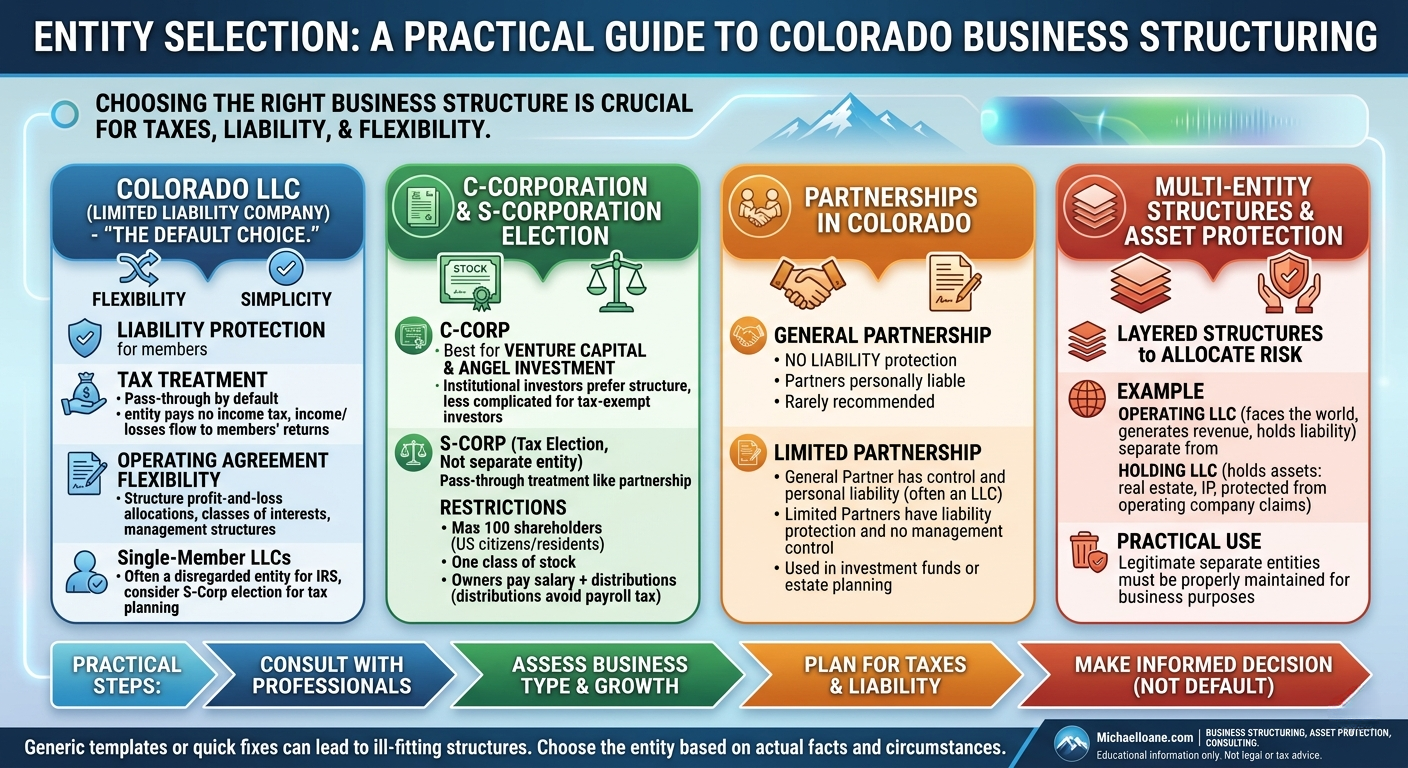
The LLC is the default choice for most Colorado businesses, and for good reason. It provides liability protection for its members without requiring the formal structure of a corporation. It defaults to pass-through federal tax treatment, meaning the entity itself does not pay income tax; instead, income and losses flow through to the members and are reported on their personal returns.
The LLC also offers significant flexibility in its operating agreement. Unlike a corporation, where shareholder agreements are constrained by corporate law defaults, an LLC operating agreement can be structured almost any way the members want, including disproportionate profit-and-loss allocations, different classes of membership interests, and customized management structures. Colorado courts generally enforce operating agreement provisions that are clearly drafted and agreed upon by the members.
For a single-member LLC, the default federal tax treatment is a disregarded entity, meaning the IRS treats it as if it does not exist for income tax purposes, and the owner reports income on a Schedule C or E, depending on the nature of the business. This is often appropriate, but there are situations, particularly for self-employment tax planning, where electing S-Corp taxation for a single-member LLC produces a better outcome.
When a Corporation Makes More Sense
There are scenarios where the LLC structure is not the right fit. Businesses that expect to raise venture capital or angel investment frequently need a C-corporation structure because institutional investors are generally not willing to hold LLC membership interests. The reason is primarily structural: LLCs complicate investor tax reporting through K-1 filings and create issues for tax-exempt investors that C-Corp preferred stock does not.
The S-corporation is not a separate entity type in Colorado; it is a federal tax election made on behalf of a corporation (or LLC). An S-Corp election restricts the number of shareholders to 100, requires that all shareholders be U.S. citizens or residents, and allows only one class of stock. Within those constraints, it offers the pass-through treatment of a partnership, without self-employment tax, on the portion of income classified as a distribution rather than as salary. The S-Corp structure is commonly used by profitable small businesses in which the owner-operator receives a reasonable salary and makes additional distributions that are not subject to payroll tax.
Partnerships and the Colorado Limited Partnership
General partnerships in Colorado offer no liability protection; each partner is personally liable for the partnership’s obligations. They are rarely the right choice for business operations, though they are sometimes used in specific investment structures in which all partners are LLCs or other protected entities.
The limited partnership provides liability protection for limited partners who do not participate in management, while the general partner retains both control and personal liability. In practice, the general partner in a limited partnership structure is typically an LLC, which insulates the individuals behind it. This structure is commonly used in investment fund contexts and in some family limited partnership arrangements designed for estate planning purposes.
Multi-Entity Structures in Colorado
For businesses with meaningful assets or multiple lines of operation, a single entity is often not the right answer. A typical Colorado multi-entity structure might involve a Colorado LLC that operates the business, a separate Wyoming LLC that holds intellectual property or real estate, and potentially a management company that provides services across both.
This kind of structure is not tax evasion and is not exotic; it reflects the legitimate use of separate legal entities to allocate risk. The operating company faces the world, takes on liability, and generates revenue. The holding entities own assets that would otherwise be exposed to claims against the operating company. As long as the entities are genuinely separate, properly maintained, and operate for legitimate business purposes, this kind of layering is entirely appropriate.
Practical Guidance on Entity Selection
The right entity depends on the actual facts of the business. A freelance consultant needs something different than a multi-owner real estate investment group. A licensed contractor needs something different than a software company. Defaulting to whatever is easiest to form, or to whatever a generic legal website recommends, without considering the specific circumstances, is the structural equivalent of buying an off-the-rack suit for a custom-fit requirement.
Entity selection in Colorado is a practical decision that benefits from direct, informed analysis rather than generic frameworks. For more information on how these structures work in real-world consulting and business contexts, visit MichaelIoane.com, where Michael Ioane covers business structuring, asset protection, and related consulting topics.
The information in this article reflects general structural principles and practical observations from consulting experience and is provided for educational purposes only. It should not be interpreted as individualized legal or tax advice.
Expand your knowledge of asset protection, business planning, taxation, and private trusts. Explore the available books on Amazon.