

Forming a Corporation in Illinois
There is a difference between filing the paperwork to form a corporation and actually building a properly structured corporate entity. Both matter, but most of the practical work happens after the Secretary of State accepts the Articles of Incorporation and issues the file-stamped confirmation. Understanding what goes into forming a corporation in Illinois, from the initial filing through the governance setup, gives founders a clearer picture of what they are actually building.
Choosing Between a C-Corp and S-Corp
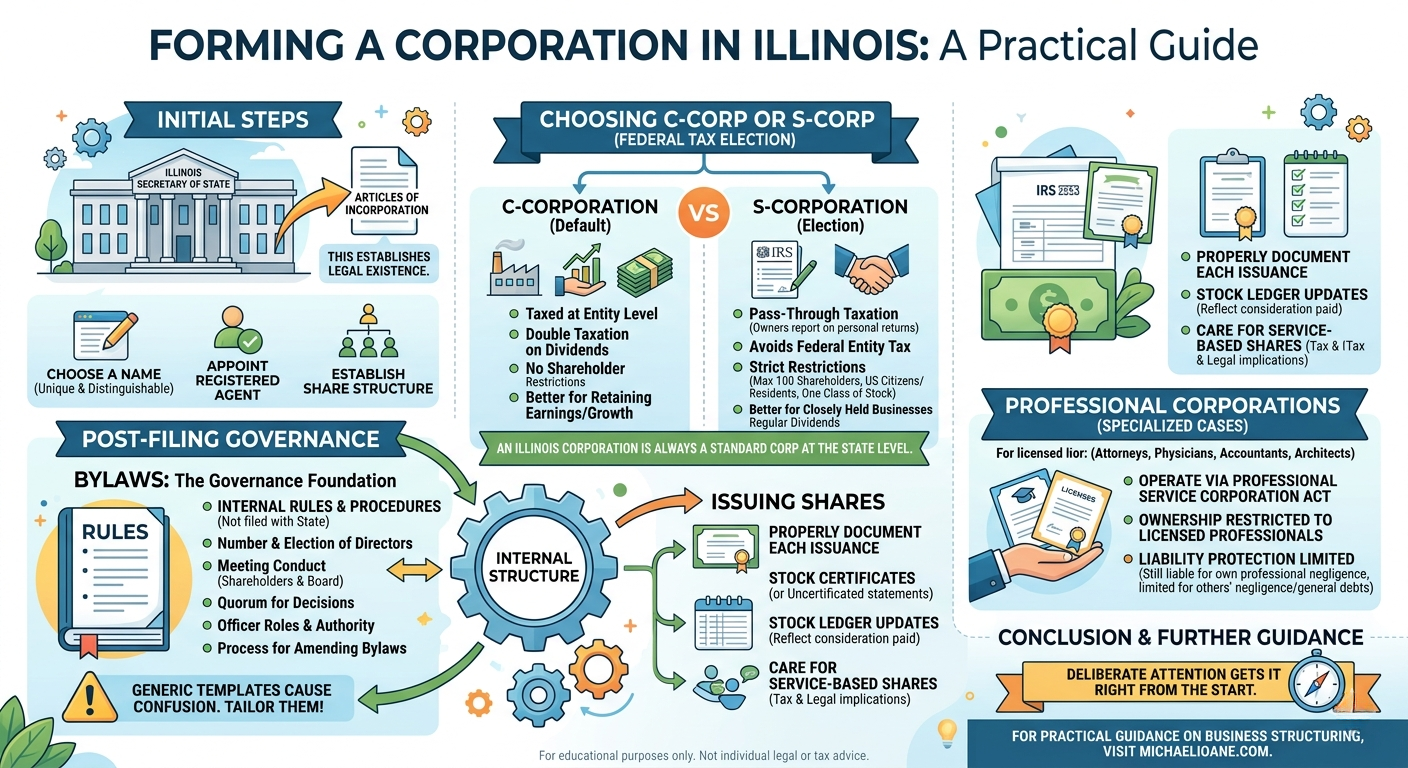
When someone talks about forming a corporation in Illinois, the entity type being formed is always a standard corporation under the Illinois Business Corporation Act. The distinction between a C-corporation and an S-corporation is a federal tax classification, not a separate state entity type. An Illinois corporation is a C-corporation by default; if the shareholders want S-corporation tax treatment, they must file Form 2553 with the IRS after formation to make that election.
The practical difference is significant. A C-corporation is taxed at the entity level on its income, and shareholders are taxed again when they receive dividends, which creates what is commonly referred to as double taxation. An S-corporation passes income and loss through to shareholders, who report it on their personal returns, avoiding entity-level federal income tax. The S-corporation election comes with restrictions: no more than 100 shareholders, all of whom must be U.S. citizens or residents, and only one class of stock is permitted.
For a small, closely held corporation with owners who intend to take money out of the business regularly, the S-election often produces a better tax result. For a corporation that intends to retain earnings and grow, or that expects to raise venture capital, the C-corporation structure may be more appropriate.
The Articles of Incorporation
The Articles of Incorporation filed with the Illinois Secretary of State are a relatively brief document. They establish the corporation’s existence, name, share structure, and registered agent. They do not govern how the corporation operates internally; that is the role of the bylaws.
Illinois allows corporations to include optional provisions in the Articles that alter or supplement the default rules under the Business Corporation Act. For example, the Articles can include provisions that limit or eliminate director liability for certain actions, or that require supermajority approval for specific corporate decisions. Whether to include those provisions depends on the specific situation and the relationship between the shareholders.
Bylaws: The Governance Foundation
The corporate bylaws are the internal governance document that most founders underinvest in during the formation process. Illinois does not require bylaws to be filed with the Secretary of State, so their absence is not immediately visible. The problem surfaces when disputes arise between shareholders, when the corporation needs to take a formal action, or when a bank or counterparty requests evidence of the corporation’s authority to enter into a transaction.
Bylaws should address, at minimum, the number of directors and how they are elected; how meetings of the board and shareholders are called and conducted; what constitutes a quorum for decision-making; the roles and authority of each officer position; how shares are issued and transferred; and the process for amending the bylaws themselves. A set of bylaws copied from a generic template, without being tailored to the specific corporation, frequently creates confusion rather than clarity.
Issuing Shares
Once the corporation is formed and the organizational meeting has taken place, shares must be issued to the initial shareholders. In Illinois, the issuance of shares must be properly documented: each shareholder receives a stock certificate or, in a corporation that has opted for uncertificated shares, a written statement of their ownership. The corporation’s stock ledger should reflect each issuance, the consideration paid, and the number of shares issued.
If founders are contributing services rather than cash or property in exchange for shares, there are both tax and corporate law considerations to address carefully. The IRS has specific rules about the tax treatment of property contributed to a corporation in exchange for stock, and Illinois corporate law requires that shares be issued for adequate consideration.
Professional Corporations in Illinois
Licensed professionals in Illinois, including attorneys, physicians, accountants, architects, and others regulated by professional licensing boards, are generally required to operate through a professional corporation rather than a standard business corporation. The Illinois Professional Service Corporation Act governs these entities. Professional corporations provide the same basic structure as standard corporations but with restrictions on ownership: only licensed professionals in the same or a related field may own shares.
Liability protection in a professional corporation is more limited than in a standard corporation. Shareholders in a professional corporation are still personally liable for their own professional negligence. The structure limits liability for the negligence of other shareholders and for the corporation’s general business obligations, but it does not insulate a licensed professional from responsibility for their own malpractice.
Forming a corporation in Illinois is a process that benefits from deliberate attention at each stage, from the initial filing through share issuance and governance documentation. Getting those steps right from the beginning is considerably easier than correcting them later. For practical guidance on business structuring, visit MichaelIoane.com.
The information in this article reflects general structural principles and practical observations from consulting experience and is provided for educational purposes only. It should not be interpreted as individualized legal or tax advice.
Expand your knowledge of asset protection, business planning, taxation, and private trusts. Explore the available books on Amazon.