
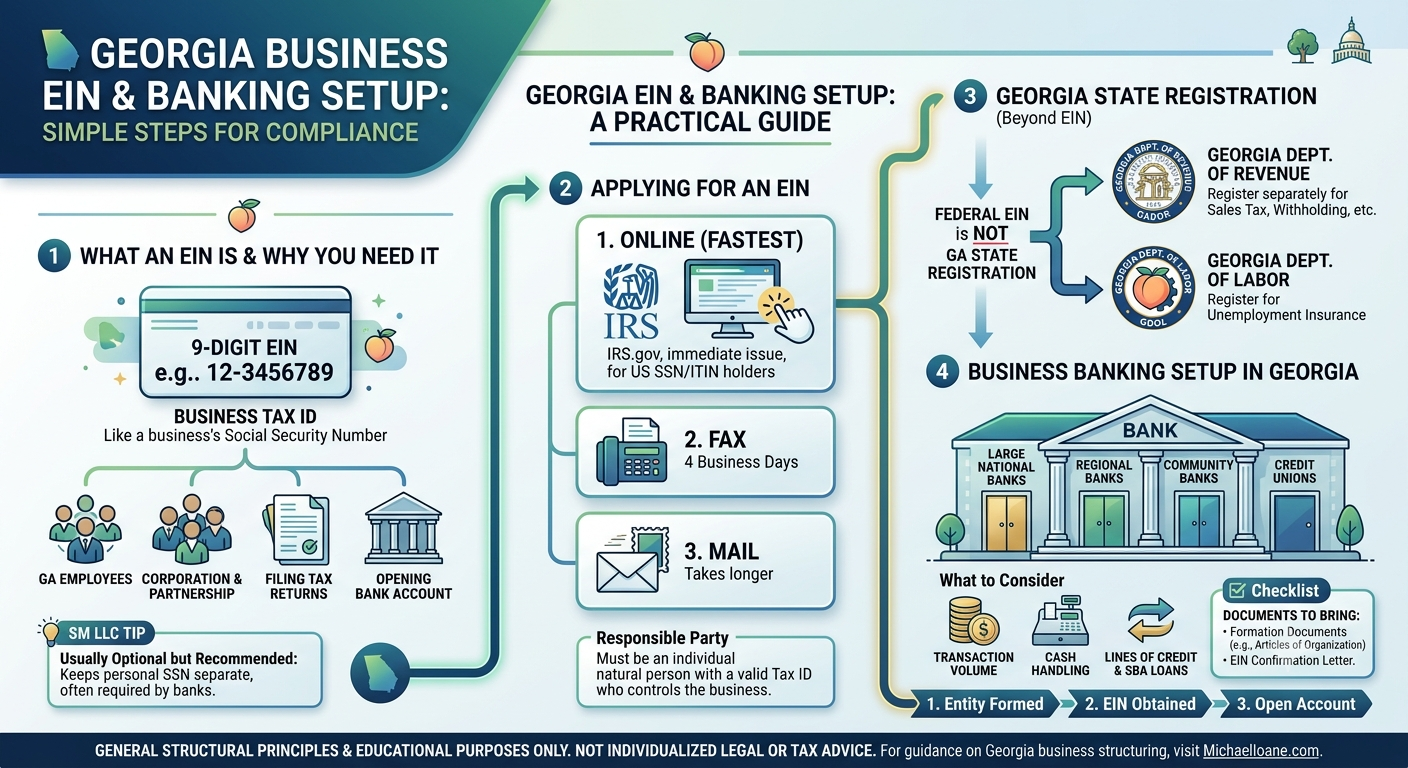

Georgia EIN and Banking Setup
Getting an Employer Identification Number and opening a business bank account are two of the earliest operational steps a Georgia business takes after formation. They are often treated as administrative tasks to be dispatched quickly, but the decisions made at this stage, including which bank to use, how the account is titled, and how the EIN is applied for, have practical consequences for the business going forward.
This article covers the EIN process for Georgia businesses, the subsequent banking setup, and the relationship between these steps and the broader compliance picture for Georgia entities.
What an EIN Is and When It Is Required
An Employer Identification Number is a nine-digit tax identification number issued by the Internal Revenue Service. It functions as the federal tax ID for a business entity, the equivalent of a Social Security number for an individual. The IRS uses the EIN to identify the entity in tax filings, correspondence, and administrative matters.
Georgia businesses need an EIN in several specific situations: when the entity has employees; when the entity is a corporation or partnership regardless of whether it has employees; when the entity files certain federal tax returns, including employment taxes, excise taxes, or returns for estates and trusts; and when the entity opens a business bank account, as most banks require an EIN to open an account in a business name.
A single-member LLC with no employees and not electing to be taxed as a corporation is treated as a disregarded entity by the IRS and technically does not need an EIN for federal income tax purposes, since income flows through to the owner’s Social Security number. In practice, however, most single-member LLCs obtain an EIN anyway because banks require it, because it avoids using the owner’s personal Social Security number on vendor and contractor forms, and because it provides a cleaner separation between the individual and the business.
Applying for an EIN as a Georgia Business
The IRS issues EINs at no charge. The fastest method is the online application on the IRS website, available to applicants with a valid Social Security number or Individual Taxpayer Identification Number. The online application is completed in a single session, and the EIN is issued immediately upon completion.
Georgia businesses that prefer to apply by fax can submit Form SS-4 and receive an EIN by return fax within four business days. Mail applications are also accepted but take considerably longer. For foreign nationals forming U.S. entities who do not have a Social Security number or ITIN, a telephone application is available.
The party responsible listed on the EIN application must be an individual, not another entity. Since 2014, the IRS has required that the party responsible be a natural person with a valid taxpayer identification number, unless the applicant is a government entity. The responsible party is the person who controls, manages, or directs the entity and its funds.
Connecting the EIN to Georgia State Registration
Obtaining a federal EIN does not satisfy Georgia’s state tax registration requirements. Georgia businesses that have employees, collect sales tax, or owe other state-administered taxes must register separately with the Georgia Department of Revenue. The state registration process results in a Georgia withholding tax identification number and, where applicable, a sales tax number.
Georgia businesses with employees must also register for state unemployment insurance with the Georgia Department of Labor. These registrations are separate from the EIN and from each other; a business that operates in Georgia with employees needs to complete each one.
Business Banking Setup in Georgia
Opening a business bank account in Georgia after formation and issuance of an EIN is the next operational step. The account provides the financial separation between personal and business funds that is essential for both liability protection and clean bookkeeping.
Georgia business owners have access to a range of banking options, from large national institutions to community banks and credit unions. The right choice depends on the business’s specific needs, including transaction volume, merchant services requirements, cash-handling needs, and whether the business expects to need a line of credit or SBA financing in the near term.
The EIN and banking setup process for a Georgia business is straightforward when approached in the right sequence: form the entity, obtain the EIN, then open the account with the formation documents and EIN confirmation in hand. For additional practical guidance on Georgia business structuring and compliance, visit MichaelIoane.com.
The information in this article reflects general structural principles and practical observations from consulting experience and is provided for educational purposes only. It should not be interpreted as individualized legal or tax advice.
Expand your knowledge of asset protection, business planning, taxation, and private trusts. Explore the available books on Amazon.