
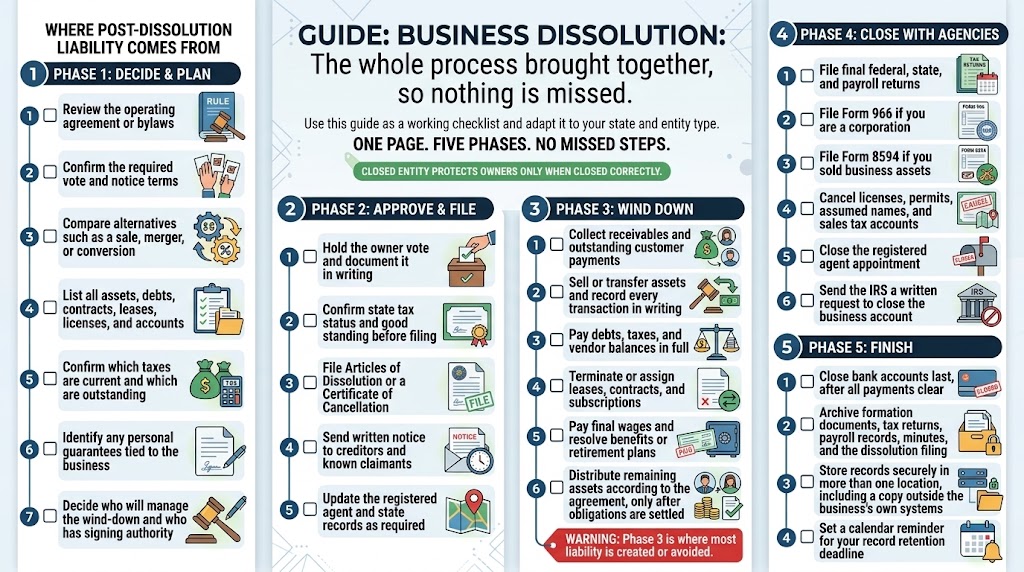

Guide: Business Dissolution
One page. Five phases. No missed steps.
This guide brings the whole dissolution process together so you can work through it in order. Use it as a working checklist and adapt it to your state, entity type, and the complexity of your business. Each phase below includes the practical detail that separates a checklist you can actually follow from one that only looks complete on paper.
Phase 1: Decide And Plan
Good planning prevents most surprises later. Do not skip this phase, even for small, simple entities, since a few hours of review here can save weeks of cleanup afterward.
☐ Review the operating agreement or bylaws
☐ Confirm the required vote and notice terms
☐ Compare alternatives such as a sale, merger, or conversion
☐ List all assets, debts, contracts, leases, licenses, and accounts
☐ Confirm which taxes are current and which are outstanding
☐ Identify any personal guarantees tied to the business
☐ Decide who will manage the wind down and who has signing authority
Phase 2: Approve And File
☐ Hold the owner vote and document it in writing
☐ Confirm state tax status and good standing before filing
☐ File Articles of Dissolution or a Certificate of Cancellation
☐ Send written notice to creditors and known claimants
☐ Update the registered agent and state records as required
Phase 3: Wind Down
This is where most liability is created or avoided, so treat this phase as the most important one, not the fastest one to rush through.
☐ Collect receivables and outstanding customer payments
☐ Sell or transfer assets and record every transaction in writing
☐ Pay debts, taxes, and vendor balances in full before anything else
☐ Terminate or assign leases, contracts, and subscriptions
☐ Pay final wages and resolve benefits or retirement plans
☐ Distribute remaining assets according to the agreement, only after obligations are settled
Phase 4: Close With Agencies
☐ File final federal, state, and payroll returns
☐ File Form 966 if you are a corporation
☐ File Form 8594 if you sold business assets
☐ Cancel licenses, permits, assumed names, and sales tax accounts
☐ Close the registered agent appointment
☐ Send the IRS a written request to close the business account
Phase 5: Finish
☐ Close bank accounts last, after all payments clear
☐ Archive formation documents, tax returns, payroll records, minutes, and the dissolution filing
☐ Store records securely in more than one location, including a copy outside the business’s own systems
☐ Set a calendar reminder for your record retention deadline
Typical Timeline
Weeks one and two cover reviewing documents, holding the vote, and gathering financial information. Weeks three through six cover filing with the state, notifying creditors, and beginning to pay obligations. From week six through twelve and beyond, owners complete asset sales, distributions, and final tax filings. Simple entities with no employees may finish in a few weeks, while entities with payroll, debts, or creditor claim periods can take several months. Building in some buffer time for state processing delays is generally wise, since agencies do not always move at the pace an owner would prefer.
Who Should Be Involved
Depending on the complexity of the entity, a complete dissolution often benefits from coordination between the owners, an accountant who can handle final returns and payroll filings, and, where debts, disputes, or multiple owners are involved, an attorney who can advise on creditor notice and the wind up process. For a simple, debt free, single owner entity, much of this can be handled directly with good guidance and a careful checklist.
Five Mistakes This Guide Helps You Avoid
- Distributing money before creditors are paid in full
- Closing the bank account before all payments clear
- Forgetting final payroll and sales tax returns
- Leaving personal guarantees unresolved and unreleased
- Discarding records too early, before the retention period has passed
Frequently Asked Questions
Q: Can I do this myself?
Simple cases can be handled by owners, but state rules, tax filings, and liability decisions are difficult to reverse if handled incorrectly, so it is worth a professional review even for a do it yourself closure.
Q: What if my entity was already administratively dissolved?
You may need to reinstate it, pay back fees, and then dissolve it voluntarily to reach a clean closure. Requirements vary considerably by state.
Q: What if one owner will not cooperate?
Review the operating agreement first. Deadlock provisions, buyout terms, and in some states court supervised dissolution may apply, so this scenario in particular benefits from legal advice.
Q: How much does a typical dissolution cost?
State filing fees are usually modest, but total cost depends heavily on whether there are debts to resolve, employees to pay out, or professional fees for accounting and legal support.
CALL TO ACTION: Want this handled for you? Acacia Management coordinates the entire dissolution, from paperwork and filings to final returns and record retention, so nothing is missed. Contact us today for a consultation.
Expand your knowledge of asset protection, business planning, taxation, and private trusts. Explore the available books on Amazon.