
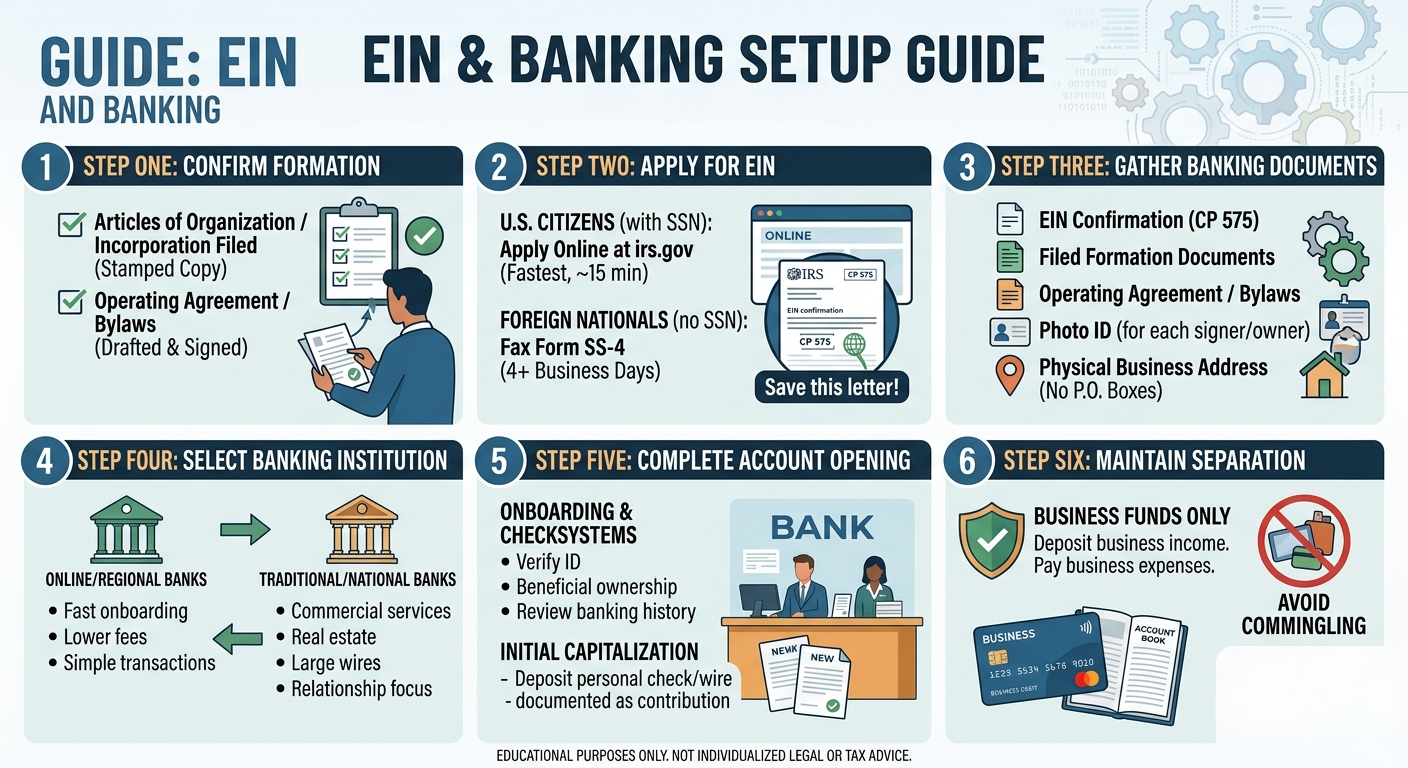

Guide: EIN and Banking
By Michael Freeman | Acacia
This guide walks through the EIN application and business banking setup process in order that things actually happen. It is written for someone who has formed or is in the process of forming a business entity and needs to move through these steps efficiently and without the common delays that derail the process.
Step One: Confirm Your Formation Documents Are Complete
Before applying for an EIN, the entity must be formed. For an LLC, that means the articles of organization have been filed with and accepted by the state, and you have the filed stamped copy or the state’s confirmation of filing. For a corporation, the articles of incorporation should be filed and accepted.
The operating agreement (for an LLC) or bylaws (for a corporation) should also be drafted and signed at this point, even though these documents are not filed with the state. They are internal governance documents, but banks will ask for them and having them ready before you approach a bank is the right sequence.
Confirm that the entity name as it appears on the state filing documents is exactly what you intend to use going forward. Any discrepancy between the state filing name, the EIN confirmation, and the banking documents will cause friction.
Step Two: Apply for the EIN
For U.S. citizens and residents with a valid SSN acting as the responsible party, the online application at irs.gov is the fastest route. The application takes approximately 15 minutes if you have the necessary information ready. You will need the legal name of the entity exactly as it appears on the formation documents, the responsible party’s name and SSN, the entity type, the reason for applying, and the entity’s principal business address.
Select the entity type carefully. An LLC with one member that has not made any tax election is a single-member LLC. An LLC with two or more members is a partnership for federal tax purposes unless an election has been made. If the LLC has elected S corporation or C corporation treatment, that election should be reflected in the application.
Upon successful completion, the IRS will display the EIN immediately and provide a confirmation notice (CP 575) that can be downloaded and printed. Save this document. Banks will ask for it, and the IRS does not reissue it easily; replacement letters can be requested but take time.
For foreign nationals without a U.S. SSN, complete Form SS-4 and fax it to the IRS at the number listed in the form instructions for international applicants. Include a cover page with a contact name and fax number for the response. Processing typically takes four business days, though it can vary.
Step Three: Gather Your Banking Documentation
Before approaching any bank, assemble the following: the EIN confirmation letter (CP 575 or IRS EIN assignment letter), the state-filed formation documents with the state’s stamp or acceptance confirmation, the fully executed operating agreement or bylaws, a government-issued photo ID for each person who will be listed as an authorized signer or beneficial owner, and the physical address of the entity (P.O. boxes are generally not accepted as the primary address).
If the entity operates under a name other than its legal name, a fictitious business name certificate (doing-business-as filing) from the appropriate jurisdiction will also be required. Not all entities need this, but if you’re branding or operations use a trade name that differs from the legal entity name, it is worth resolving before the banking conversation.
Step Four: Select the Right Banking Institution
Match the institution to the entity’s needs. A straightforward domestic LLC with one or two members, no international components, and routine transaction activity can be well-served by an online business banking platform, a regional bank, or a major national institution. Each has trade-offs in onboarding time, fee structure, and service accessibility.
If the entity is engaged in real estate transactions, large wire transfers, or commercial lending activity, a traditional bank with a commercial banking department is generally more appropriate. The relationship and the institution’s comfort with the transaction profile matter over time.
Call ahead or check the bank’s website for its specific documentation requirements before arriving. Some banks have updated their onboarding requirements and can tell you exactly what to bring. Showing up without a required document simply means a return visit.
Step Five: Complete the Account Opening
At the account opening appointment, the bank will collect your documents, verify identification, complete beneficial ownership certification for all individuals who own 25 percent or more of the entity and the person with primary control, and, in most cases, run a ChexSystems inquiry on the authorized signatories. ChexSystems is a consumer reporting agency that tracks banking history; a significant derogatory record can complicate account opening at certain institutions.
Once the account is open, request a deposit slip and confirm the account number and routing number. Set up online access during the meeting if the bank offers that option. Fund the account with the initial deposit, which, in most cases, can be a personal check or a wire transfer from the owner’s personal account. This initial transfer is not prohibited commingling; it is the initial capitalization of the entity.
Step Six: Maintain Separation Going Forward
The most important thing after the account is open is keeping it operationally separate from personal finances. All business income should be deposited into a business account. All business expenses should be paid from the business account. Transfers between the business account and personal accounts should be documented as distributions, loans, or capital contributions, depending on the entity type and the purpose.
This is not a bureaucratic concern. In the event of litigation, a creditor’s attempt to pierce the corporate veil, or an IRS audit, the integrity of the financial separation is central. Entities that have commingled funds, paid personal expenses from the business account without proper documentation, or operated without consistent financial records are significantly more vulnerable.
Acacia provides formation and compliance support that covers EIN procurement, banking documentation preparation, and ongoing entity maintenance. For additional commentary on business structuring and compliance, MichaelIoane.com is a useful resource.The information in this article reflects general structural principles and practical observations from consulting experience and is provided for educational purposes only. It should not be interpreted as individualized legal or tax advice
Expand your knowledge of asset protection, business planning, taxation, and private trusts. Explore the available books on Amazon.