

Essential Georgia EIN Setup and Compliance
The Georgia EIN Setup is not technically difficult. Compliance issues arise regularly when the process is rushed. They also appear when steps are incomplete or federal and state requirements aren’t understood. Understanding how these requirements intersect helps business owners avoid delays and penalties.
This guide covers the most common compliance issues in the Georgia EIN and banking setup process. It explains practical steps to avoid errors that delay approvals or trigger penalties. By following these steps, businesses can align federal and state obligations effectively. The framework also clarifies responsibilities for owners and staff across filing, documentation, and record-keeping.
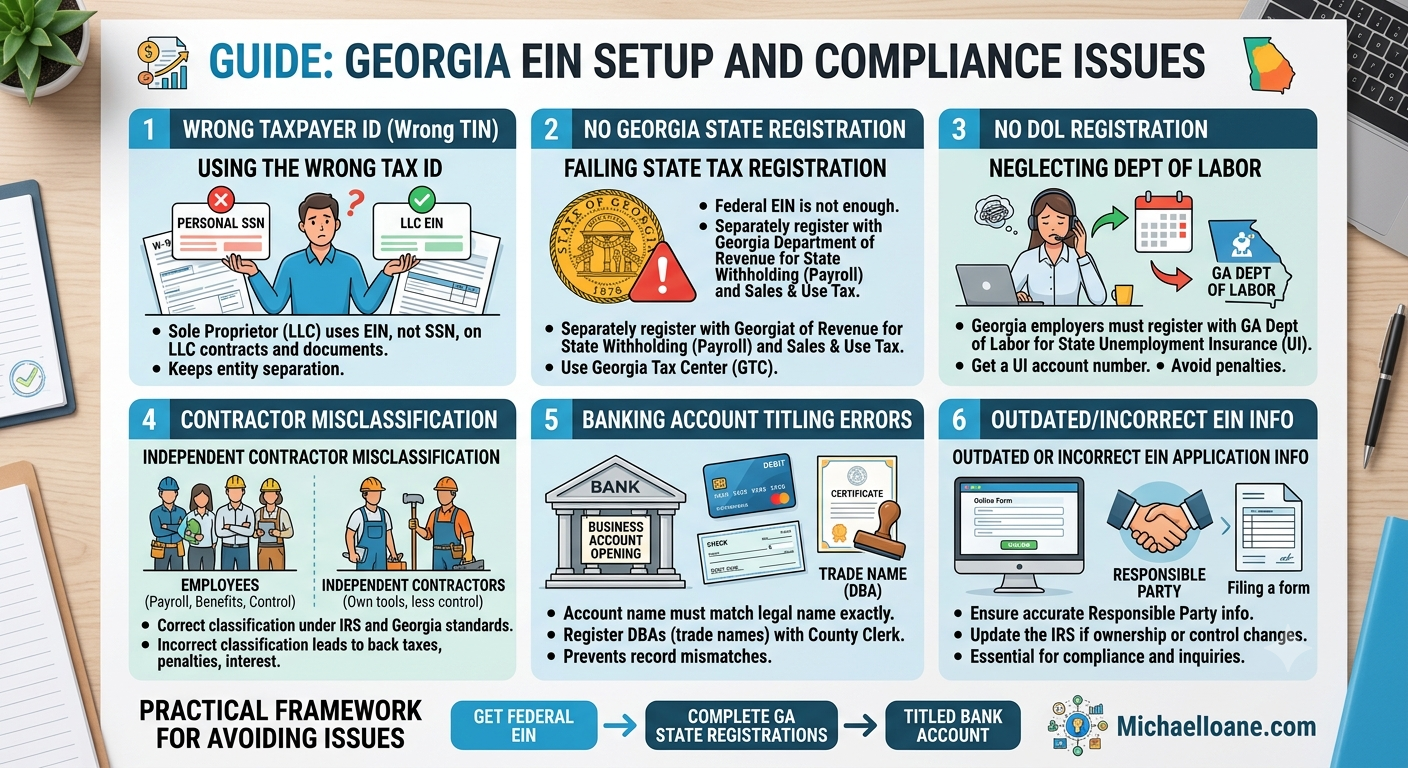
Compliance Issue One: Using the Wrong Taxpayer Identification Number
One of the more common early mistakes is using the wrong taxpayer identification number on business documents. Georgia business owners often repeat this error on documents. This specifically affects Georgia business owners who operate with a separate entity. This distinction helps prevent misfiling and potential audits for the business.
A sole proprietor who forms a Georgia LLC and obtains an EIN must use the LLC’s EIN. Do not use your personal Social Security number on documents issued by the LLC. In addition, using the personal number on W-9 forms, vendor applications, or client contracts creates record inconsistency. That inconsistency can complicate tax filing and blur the separation between the individual and the entity. This is part of the Georgia EIN Setup.
Similarly, if the business later elects S-corporation taxation, the EIN will remain the same. The tax filings will change. The EIN does not change with the tax classification election; it remains the entity’s permanent identifier. Keeping track of which number belongs in which context avoids errors that require IRS correspondence to be corrected.
Compliance Issue Two: Failing to Complete Georgia State Tax Registration
Obtaining a federal EIN does not automatically register the business with the Georgia Department of Revenue. Therefore, you must take additional steps to comply with Georgia tax rules. This ensures proper state tax registration and reporting. Failure to complete these steps can lead to penalties.
Businesses selling taxable goods or services in Georgia must separately register for sales and use tax. This registration is not automatic; it requires affirmative action through the Georgia Tax Center. Completing this step helps ensure timely tax remittance and compliance.
A Georgia business that pays employees without the state withholding registration is not in compliance with Georgia law. This also affects Georgia EIN Setup. Regardless of whether federal employment taxes are being handled correctly, noncompliance remains a concern. Prompt registration helps avoid penalties and ensures proper payroll reporting.
The Georgia Department of Revenue and the IRS have separate registration requirements. Relying on one agency’s process does not fulfill the other’s obligations. Businesses must complete the appropriate forms and submit them to the correct agency. Failure to register can delay payroll, trigger penalties, and complicate future filings.
Therefore, Georgia employers should verify both registrations before paying employees. Coordination with a tax adviser can help ensure timely completion. If you are unsure of the steps, contact the Georgia Department of Revenue or the IRS for guidance. Acting now reduces risk and supports compliant payroll operations.
Compliance Issue Three: Not Registering with the Georgia Department of Labor
Georgia employers must register with the Georgia Department of Labor for state unemployment insurance purposes. This registration is required once the business pays wages to employees in Georgia above a minimum threshold. The registration results in a Georgia unemployment insurance account number, which is used for quarterly filing and payment of state unemployment contributions.
Businesses that hire workers and do not register for Georgia unemployment insurance risk back contributions. This applies when the oversight is discovered.
The registration process itself is straightforward. Compliance issues arise from not knowing the requirement exists or delaying it while getting the business operational.
Compliance Issue Four: Independent Contractor Misclassification
Georgia businesses that engage workers must classify them accurately under federal and state standards. Georgia EIN Setup matters when workers are treated as independent contractors rather than employees.
The IRS uses a multifactor test to assess worker status for compliance. It considers behavioral control, financial control, and the type of relationship in many cases. Georgia also has its own standards for specific purposes. These include workers’ compensation and unemployment insurance.
Misclassifying employees as independent contractors has significant consequences. The business becomes liable for its share of employment taxes that should have been withheld and remitted. This includes penalties and interest. Failing to classify properly also affects tax reporting forms and withholding documentation.
If the misclassification affects Georgia unemployment insurance or workers’ compensation coverage, there are separate state consequences as well. These rules require proper employer classifications to determine eligibility for benefits and coverage. Incorrect classifications can lead to higher premiums, audits, or penalties. Staying compliant protects workers and the business from cost and disruption.
The EIN and payroll tax registration process makes this issue concrete. A business that issues 1099s to workers who should be on payroll has exposure that will surface. Correct classification during registration prevents liability and aligns with tax obligations. Proactive steps now can avoid audits and penalties later.
Compliance Issue Five: Banking Account Titling Errors
The business bank account must use the entity’s legal name, exactly as filed with Georgia’s Secretary of State.
Operating under a trade name without a registered DBA in Georgia creates a record mismatch. That mismatch can complicate check deposits, merchant account applications, and contract enforcement, jeopardizing the Georgia EIN Setup.
Georgia requires businesses operating under a name other than their legal entity name to register that trade name. The registration must be with the county clerk in the county where the business is located.
This registration is separate from the Secretary of State filing and from the EIN. A business that issues invoices under a trade name has its bank account in that name. If the DBA is not registered, it may encounter practical problems in collecting those invoices.
Compliance Issue Six: Outdated or Incorrect EIN Application Information
The information submitted on the EIN application should reflect who controls the entity. This includes the responsible party’s name and TIN. Accurate records support compliance and clear ownership. This alignment helps avoid misrepresentation during processing by the IRS.
If the business structure changes after the EIN is issued, notify the IRS. This includes ownership changes or a replacement of the responsible party. Timely updates help keep records current. Such updates ensure ongoing accuracy in government filings and reporting.
The IRS takes the responsible party information seriously as part of its efforts to prevent fraudulent use of EINs.
Businesses with inaccurate responsible party information on file may later face IRS inquiries or audits. The resulting discrepancy can complicate matters unnecessarily.
Compliance issues in the Georgia EIN and banking setup context are largely avoidable. This hinges on a clear understanding of the requirements.
The federal EIN is the starting point. Georgia state registrations complete the picture. The banking setup provides the financial infrastructure that supports ongoing operations.
For practical consulting guidance on Georgia business structuring and compliance, visit MichaelIoane.com. Michael Ioane covers real-world business setup and compliance topics for owners and operators.
The information in this article reflects general structural principles that apply across contexts and includes practical observations from consulting experience.
It is provided for educational purposes only.
It should not be interpreted as individualized legal or tax advice.
Expand your knowledge of asset protection, business planning, taxation, and private trusts. Explore the available books on Amazon.