

Guide: Governance Documents
By Michael Freeman | Acacia
This guide is intended for someone who is either forming a new entity and wants to approach the governance documentation correctly, or who has an existing entity and wants to evaluate whether the current documents are adequate. It covers the process in practical terms, from what needs to be in the document through how to keep it current over the life of the entity.
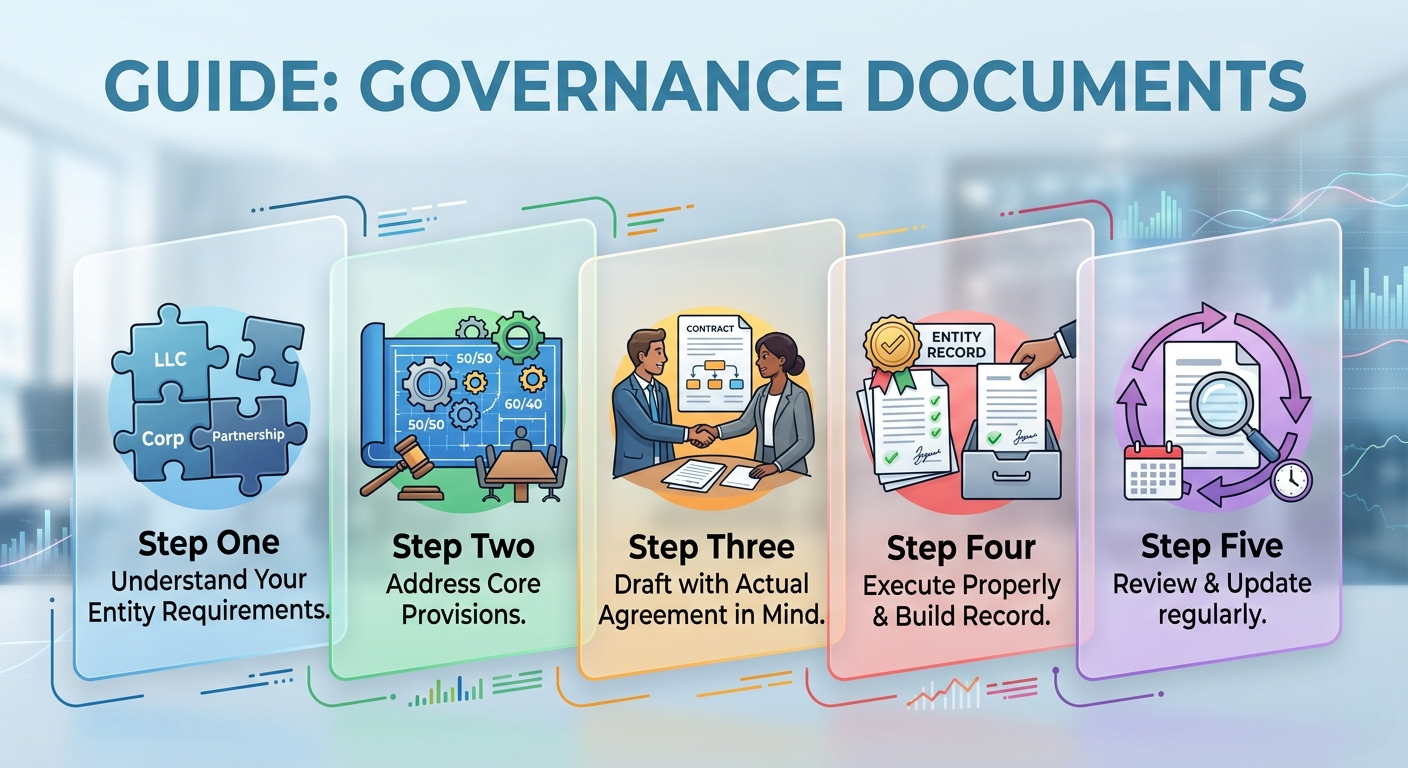
Step One: Understand What Document Your Entity Requires
LLCs use operating agreements. Corporations use bylaws, and in closely held companies, typically also a shareholders’ agreement. Partnerships use partnership agreements. Each document type has a different structure and addresses different governance questions, though there is meaningful overlap in what they accomplish.
If your entity is a single-member LLC, the operating agreement is still worth drafting properly even though there is no co-owner relationship to manage. It establishes the entity’s operational framework, documents the separation between personal and business activity, specifies the management structure, and provides a clear record of the entity’s governing terms that banks, lenders, and courts may later request.
If your entity has multiple owners, the operating agreement or shareholders’ agreement defines the relationship among those owners. It is the governing contract for the ownership group, and its quality and completeness will determine how well the structure holds up when things get complicated.
Step Two: Address the Core Provisions
Regardless of entity type, a governance document needs to address several categories of provisions. Ownership and economic interests establish who owns what percentage of the entity and how that translates into distributions and liquidation proceeds. Management authority establishes who makes decisions and what decisions require broader approval. Voting mechanics establish the thresholds for different categories of decisions. Transfer provisions establish the rules for how ownership interests can be moved, sold, or pledged.
For multi-owner entities, the document also needs to address what happens when an owner wants to leave, is forced to leave (due to death, disability, bankruptcy, or breach), or cannot agree with the other owners on a fundamental decision. These provisions are the ones that matter most in practice, and they are the ones most commonly missing or inadequately drafted in template-based documents.
For corporations specifically, the bylaws need to address the board of directors’ structure, including the number of directors, how they are elected, their terms, and their authority. They also need to address officer roles and authority, how meetings are called and conducted, and what constitutes a quorum. These are procedural provisions, but failing to follow them when making corporate decisions can create procedural defects that are later used to challenge those decisions.
Step Three: Draft with the Actual Agreement in Mind
The governing document should reflect what the parties actually agreed to, not what a template assumes they agreed to. Before drafting begins, the parties should have a clear understanding of the following: who holds what percentage of the entity and on what basis; who will manage the entity and with what scope of authority; what decisions require unanimous or supermajority approval; how distributions will be made and on what schedule; what happens if more capital is needed and a member cannot or will not contribute; and what the exit mechanism is if a member wants to leave.
These are not questions a lawyer or formation service can answer for the parties. These are business decisions that must be made by the owners before the documents are drafted. The drafting process translates those decisions into enforceable provisions. Starting the drafting process without having made those decisions produces a document that reflects the drafter’s assumptions rather than the parties’ actual intentions.
Step Four: Execute Properly and Build the Entity Record
Once the document is drafted and reviewed, proper execution requires signatures from all required parties. For an LLC, that typically means all members and, if the entity is manager-managed, the manager. For a corporation, the organizational meeting should be held, the bylaws adopted, officers appointed, and initial shares issued and documented in the share ledger. All of this should be recorded in the corporate minutes.
The entity record should include: the state filing confirmation; the operating agreement or bylaws, including all signature pages; any shareholder agreement; the initial meeting minutes; the share ledger or membership interest schedule; the EIN confirmation; and any subsequent amendments to the governing documents. This record should be kept in a consistent location and updated as the entity evolves.
Step Five: Review and Update as the Entity Changes
A governance document review should be triggered by any significant change in the entity: a new member being admitted, a member existing, a change in management structure, a significant change in the nature of the business, a capital event, or the passage of a substantial amount of time since the document was last reviewed. For active entities, reviewing the governing documents every two to three years as a matter of course is reasonable practice.
Amendments should be executed with the same formality as the original document. An amendment memorialized only in email or a handwritten note attached to the agreement does not carry the same weight as a properly drafted and executed amendment signed by all required parties. The amendment should reference the specific provision being changed, clearly state the new provision, and be kept with the original document as part of the entity’s permanent record.
Working with Formation and Compliance Services
Formation services vary considerably in the quality of governance documentation they provide. Some formation platforms provide only state filing and offer minimal or no drafting of operating agreements. Others provide template documents that may or may not be customized to the client’s situation. Working with a service that has experience with the kind of entity structure you are building and understands the governance implications of the choices being made produces materially better documentation than a generic online process.
Acacia provides entity formation and governance documentation services for clients whose structures require more than a standard template. For further commentary on governance, structuring, and entity compliance, MichaelIoane.com provides ongoing practical perspective from a consulting standpoint.
The information in this article reflects general structural principles and practical observations from consulting experience and is provided for educational purposes only. It should not be interpreted as individualized legal or tax advice.
Expand your knowledge of asset protection, business planning, taxation, and private trusts. Explore the available books on Amazon.