

The Ultimate Guide to Michigan Asset Protection
Building an effective asset protection structure for Michigan Asset Protection requires matching tools to the risk profile. Moreover, there is no single template that works for every business owner, professional, or investor. Additionally, perform a clear-eyed assessment of exposure, assets, and options under Michigan and federal law.
This guide provides a practical framework for Michigan Asset Protection. Additionally, it covers the most commonly used structuring approaches, how they fit together, and what to watch for in each.
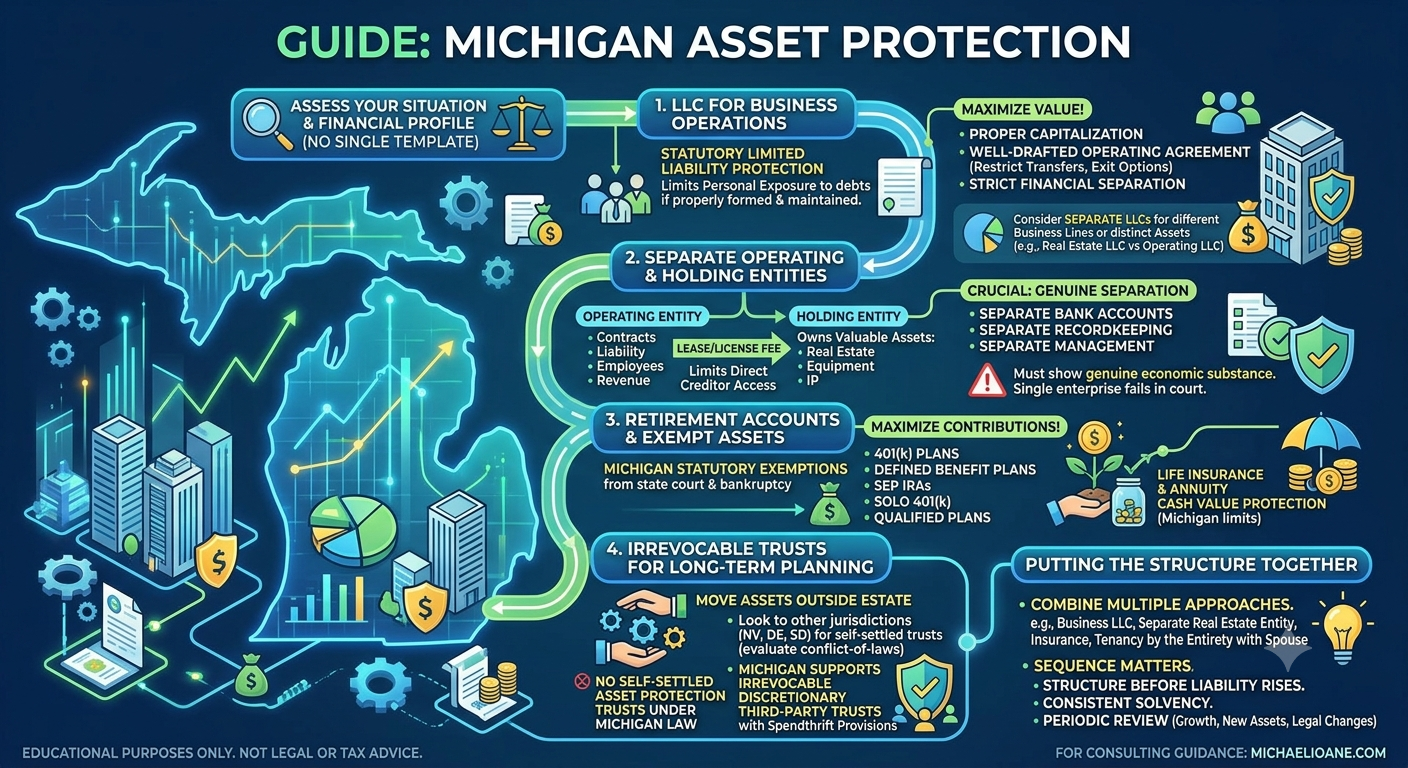
Structuring Approach One: The Michigan LLC for Business Operations
The starting point for most Michigan business owners is the LLC structure for operating activities.
The Michigan LLC provides statutory limited liability protection for its members.
This limits personal exposure to the business’s debts and obligations.
This protection rests on proper formation and maintenance of the entity.
This supports Michigan Asset Protection.
It is not a controversial or exotic planning tool.
It is the standard structural choice for operating a Michigan business.
The asset protection value of the Michigan LLC is maximized when paired with a deliberate approach to capitalization. This includes a well-drafted operating agreement and consistent separation between personal and entity finances, supporting Michigan Asset Protection.
Michigan business owners who operate multiple lines of business or hold different types of assets should consider their LLC structure.
They should decide whether separating different activities or asset classes into distinct entities offers better Michigan Asset Protection.
Holding real estate in the same entity that carries the operational liability of an active business creates risk.
Structuring Approach Two: Separating Operating and Holding Entities for Michigan Asset Protection
A widely used Michigan Asset Protection approach involves two or more entities: one operates the business and bears liability. A separate entity holds valuable assets and licenses or leases them to the operating entity. The operating company faces the world, enters into contracts, employs workers, and generates revenue. The holding company owns the real estate, equipment, intellectual property, or other valuable assets.
If the operating company faces a lawsuit, a judgment is entered against it. However, the plaintiff has a claim against the operating entity’s assets. Holding entity’s assets stay separate and support Michigan Asset Protection, while remaining inaccessible to creditors if the entities are separate.
This structure requires genuine separation and documentation. The lease or licensing agreement between the entities should be in writing and reflect market terms. The entities should have separate bank accounts, separate record-keeping, and separate management decisions. Moreover, such an arrangement will not survive veil piercing analysis in Michigan courts. This framework supports Michigan Asset Protection.
Structuring Approach Three: Retirement Accounts and Exempt Assets
Michigan’s statutory exemptions protect retirement accounts and some insurance products.
This protection operates independently of any entity structure.
Maximizing contributions to qualified retirement plans, including 401(k) plans, defined benefit plans, and SEP IRAs, helps accumulate wealth.
This Michigan Asset Protection supports wealth building within a legally protected structure.
The protection applies in both Michigan state court proceedings and federal bankruptcy.
For Michigan Asset Protection, business owners who operate through an entity can benefit from a retirement plan. Additionally, a solo 401(k) for single-member operations or a qualified plan for employees supports tax planning. Contributions reduce taxable income, accelerate tax-deferred wealth, and place funds in a protected category under Michigan and federal law.
Life insurance and annuity products with Michigan Asset Protection provide an insurance function. Additionally, these products accumulate cash value that is partially or fully protected from creditor claims under Michigan exemption statutes. The planning should account for the specific exemption limits and requirements applicable to these products.
Structuring Approach Four: Irrevocable Trusts for Michigan Asset Protection and Long-Term Planning
For Michigan Asset Protection, residents with significant assets and a planning horizon, irrevocable trusts help move assets outside the estate.
In properly structured trusts with spendthrift provisions, assets may be outside creditors’ reach.
The planning typically involves transferring assets to an irrevocable trust during the grantor’s lifetime.
This uses the federal gift and estate tax exemption to shelter the transfer from gift tax where applicable.
Michigan does not have a domestic asset protection trust statute.
However, a self-settled irrevocable trust under Michigan law generally does not protect the grantor’s assets.
For Michigan Asset Protection, residents may look to states with longstanding statutes like Nevada, South Dakota, or Delaware.
For trusts designed to benefit children, grandchildren, or other third-party beneficiaries rather than the grantor, Michigan Asset Protection applies.
Additionally, a properly drafted discretionary trust with a spendthrift clause protects assets from the beneficiary’s creditors to a significant degree.
There are exceptions for certain categories of creditors as discussed in the legal considerations article in this series.
Putting the Structure Together
A complete Michigan Asset Protection strategy usually combines several approaches rather than relying on one.
However, a business owner might operate through a Michigan LLC.
Additionally, they may hold real estate in a separate entity and maintain maximized retirement accounts.
Moreover, they carry umbrella and liability insurance and hold personal assets with a spouse in tenancy by the entirety.
The sequencing matters.
Moreover, to support Michigan Asset Protection, the structure must be in place before liability arises and funded with solvency.
Additionally, review the structure periodically to stay aligned as the business grows or assets change.
Michigan Asset Protection is a planning discipline.
Additionally, it rewards deliberate, informed decision-making rather than reactive, template-based approaches.
The tools under Michigan law are real and meaningful when used correctly and maintained consistently.
Visit MichaelIoane.com for practical consulting guidance on strategy and business structuring.
Michael Ioane covers asset protection frameworks, business structuring, and related topics for business owners, professionals, and investors.
However, the information in this article reflects general structural principles and practical observations from consulting experience on Michigan Asset Protection.
Additionally, you should not interpret it as individualized legal or tax advice.
Expand your knowledge of asset protection, business planning, taxation, and private trusts. Explore the available books on Amazon.