
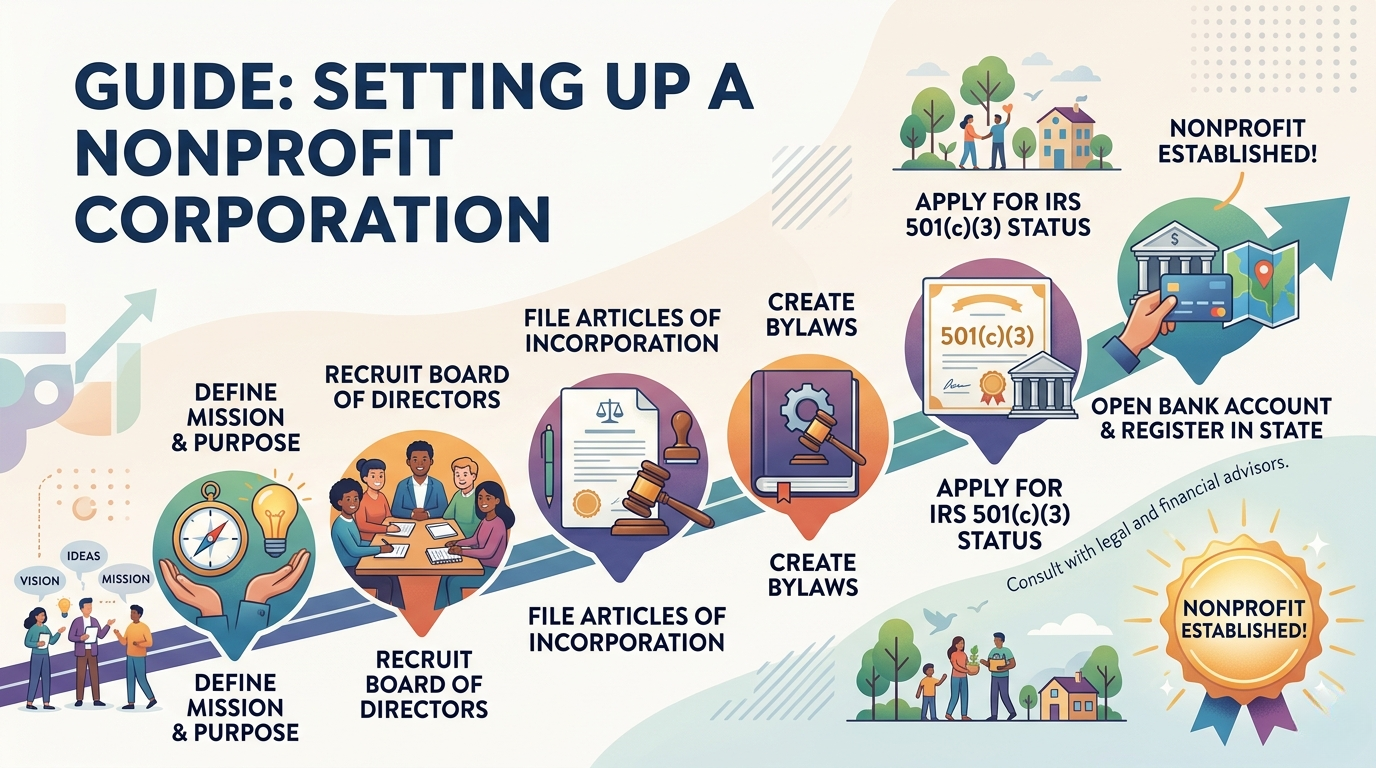

Guide: Setting Up a Nonprofit Corporation
This guide walks through the nonprofit corporation setup process in a practical sequence. It is not a substitute for legal counsel, and the specifics will vary by state and the nature of your organization. What it does offer is a clear picture of the process, the decisions involved, and the order in which things need to happen.
People come to nonprofit formation from very different starting points. Some have a clear vision and need help understanding the mechanics. Others have done some research but have gotten turned around by conflicting information. In either case, a clear, sequential picture of the process is the most useful place to start.
Step One: Define Your Mission and Structure
Before you file any documents, you need a clear statement of your organization’s purpose and a basic understanding of how it will operate. This is not a branding exercise; it is a legal and operational foundation. The IRS will scrutinize your stated purpose when reviewing your 501(c)(3) application, and vague or overly broad purpose statements create problems.
Your purpose should describe what the organization does, who it serves, and how its activities advance a recognized exempt purpose. Recognized exempt purposes under Section 501(c)(3) include charitable, religious, educational, scientific, literary, testing for public safety, fostering national or international amateur sports competition, and preventing cruelty to children or animals. Your purpose statement should map clearly to one or more of these categories.
At this stage, you should also think through your governance model: how many directors you will start with, how leadership decisions will be made, whether you anticipate having paid staff, and how the organization will initially be funded. These decisions inform the documents you draft and the choices you make in the application process.
Step Two: Choose a State and File Articles of Incorporation
Nonprofit corporations are formed under state law, which means you need to select a state of incorporation and comply with that state’s nonprofit corporation statutes. As noted in our earlier piece on nonprofit formation, most organizations should incorporate in the state where they intend to operate.
Your articles of incorporation need to include: the organization’s name, your registered agent and registered office address, your statement of purpose, a provision limiting your activities to those consistent with 501(c)(3) status, and a dissolution clause directing that assets be distributed to another tax-exempt organization upon dissolution. Without the purpose limitation and dissolution clause, the IRS will not grant tax-exempt status, regardless of how your state-filed articles look.
Filing fees vary by state and are generally modest for nonprofits. Processing times also vary; some states process filings quickly, others take several weeks. Once the articles are filed and accepted, you have a legal corporate entity.
Step Three: Obtain an Employer Identification Number
Apply for an Employer Identification Number from the IRS before you do anything else at the federal level. The EIN is essentially a tax identification number for your organization, and you will need it to open a bank account, hire employees if applicable, and file your 1023 application. The application is filed online through the IRS website and is generally processed immediately.
Step Four: Draft and Adopt Bylaws
Bylaws govern how your organization operates internally. They should be adopted by your initial board of directors at your organizational meeting, and the adoption should be recorded in your board minutes. The IRS will ask for your bylaws as part of the 1023 application, and it expects them to address specific governance topics.
Your bylaws should cover board composition and size, director qualifications and term lengths, officer positions and responsibilities, meeting frequency and notice requirements, quorum requirements, voting procedures, amendment procedures, and your conflict-of-interest policy. The conflict-of-interest policy can be incorporated into the bylaws directly or adopted as a separate policy document; either approach is acceptable.
Step Five: Hold Your Organizational Meeting
The organizational meeting is where the initial board formally adopts the bylaws, elects officers, authorizes the opening of a bank account, and addresses any other preliminary organizational matters. Everything that happens at this meeting should be documented in the minutes. Those minutes are a legal record of the organization’s initial decisions and will be requested by banks, funders, and potentially the IRS.
If your state requires an initial report or statement of information, that should be filed promptly after incorporation. Requirements vary by state.
Step Six: Apply for Federal Tax-Exempt Status
This is typically the most involved step in the process. Most organizations apply using Form 1023, which is filed online through the IRS’s Pay.gov system. Form 1023 requires detailed information about your programs, governance, finances, compensation practices, and any relationships between the organization and its insiders.
The application requires an organizing document (your articles of incorporation), your bylaws, financial data (projected or actual, depending on how long you have been operating), and a program narrative that describes your activities in sufficient detail for the IRS to confirm that they align with an exempt purpose. The narrative section is where many applications run into problems; invest time in making it clear, specific, and well-organized.
Processing times for Form 1023 have ranged widely in recent years, from a few months to over a year, depending on the complexity of the application and IRS workload. Applications that are complete and clearly organized tend to move more smoothly. Missing documents or vague narratives raise questions that delay the process.
If your application is approved, you will receive a determination letter from the IRS confirming your 501(c)(3) status. Keep this letter permanently; you will need it for banking, grant applications, and state tax exemption filings.
Step Seven: Apply for State Tax Exemption and Register for Charitable Solicitation
Federal tax-exempt status does not automatically exempt you from state taxes. Apply for state income tax exemption and state sales tax exemption through your state’s revenue department. The IRS determination letter is typically required as part of that application.
If you intend to solicit donations, register with your state’s charitable solicitation registry before you begin. Most states require this registration and annual renewal. If you plan to solicit from residents of other states, research those states’ requirements as well; multi-state registration obligations are a real compliance consideration for any organization with a national fundraising footprint.
Ongoing Compliance After Formation
Formation is the beginning, not the end, of your compliance obligations. Ongoing requirements include annual Form 990 filings with the IRS, state corporate annual reports, charitable solicitation registration renewals, and any state-specific filing requirements. Your board should receive regular financial reports, and governance policies should be reviewed periodically to ensure they reflect the organization’s operations.
Many nonprofits also benefit from periodic governance reviews or legal checkups, particularly as the organization grows or its programs evolve. What works at the $100,000 level may not be adequate at the $1 million level, and building good habits early makes scaling much easier.
The nonprofit formation process is genuinely manageable when you approach it in sequence and understand what each step is designed to accomplish. Take the time to get the foundation right, and the organization will be positioned to focus on its mission rather than having to clean up structural problems later.
Disclosure: The information in this article reflects general structural principles and practical observations from consulting experience and is provided for educational purposes only. It should not be interpreted as individualized legal or tax advice.
Expand your knowledge of asset protection, business planning, taxation, and private trusts. Explore the available books on Amazon.