

Legal Considerations in Michigan Asset Protection
Asset protection planning in Michigan operates within a web of state and federal legal constraints that shape what is achievable, what is risky, and what is simply not permitted. Understanding the legal landscape is not just a matter of avoiding problems; it is the foundation for building a structure that will actually hold up when it is tested. This article addresses the key legal considerations that any serious Michigan asset protection discussion must account for.
Federal Bankruptcy Law as a Constraint
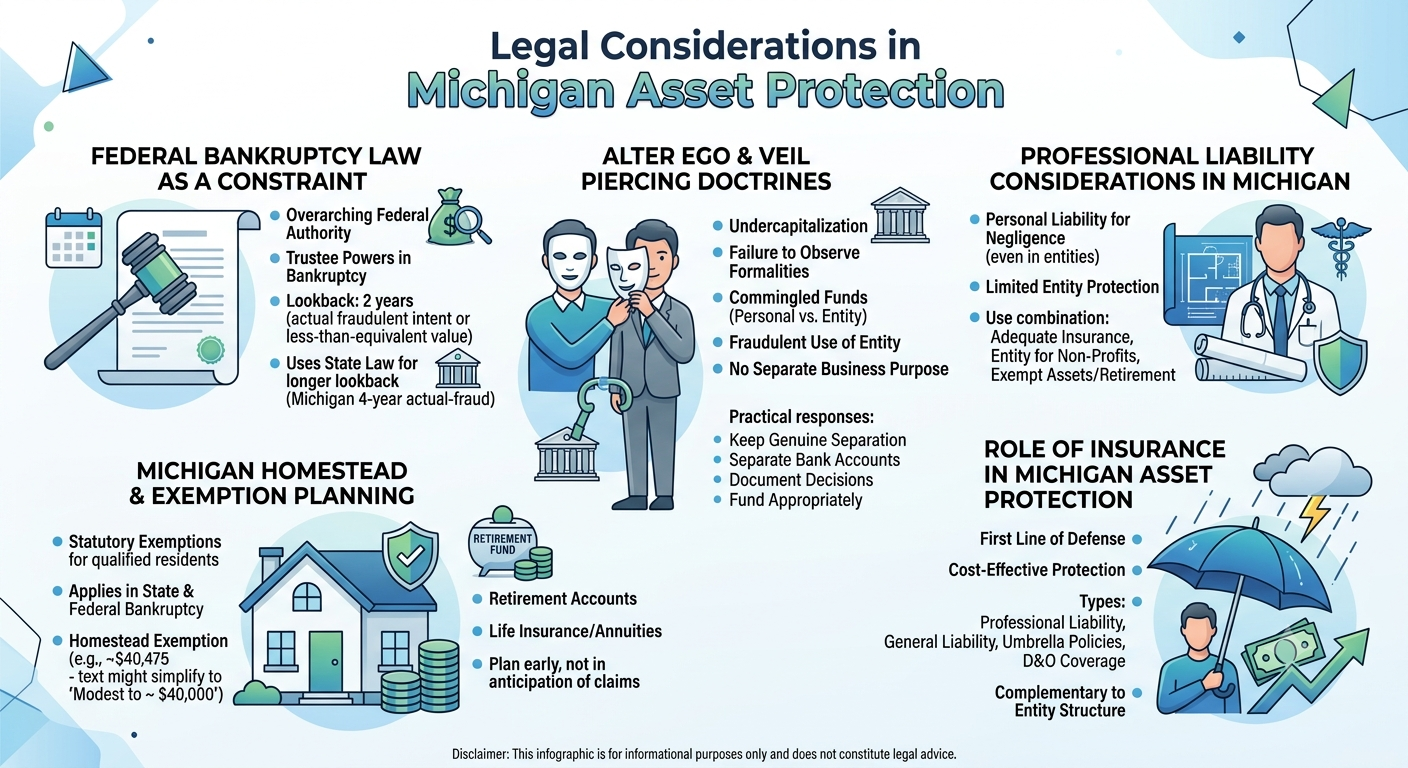
Regardless of how well a Michigan asset protection structure is designed under state law, federal bankruptcy law operates as an overarching constraint. If a debtor files for bankruptcy protection, the bankruptcy trustee has powers that do not exist outside of bankruptcy. The trustee can avoid transfers made within two years of the bankruptcy filing under Section 548 of the Bankruptcy Code if those transfers were made with actual fraudulent intent or for less than reasonably equivalent value when the debtor was insolvent.
Beyond the two-year period, the bankruptcy trustee can use state fraudulent-transfer law to reach further back, up to the state’s own lookback period, which in Michigan is 4 years for actual-fraud claims. This means a transfer made four years before a bankruptcy filing can potentially be unwound if it meets the criteria for a voidable transfer under Michigan law.
The interaction between state asset protection planning and federal bankruptcy law is one of the areas where the most significant gaps between theory and practice exist. A structure that appears to work well in a state court civil litigation context may face additional challenges if the debtor ends up in federal bankruptcy court. Planning that accounts for both contexts produces more durable results.
The Alter Ego and Veil Piercing Doctrines
Michigan courts recognize the doctrines of alter ego and veil piercing, which allow a court to disregard the liability protection of a business entity and hold its owners personally liable when the entity is not being operated as a genuinely separate legal person. The factors Michigan courts consider in veil piercing analysis include: whether the entity was undercapitalized for its operations; whether corporate or LLC formalities were observed; whether personal and entity funds were commingled; whether the entity was used to perpetrate a fraud; and whether the entity had a separate business purpose from the individual.
The alter ego doctrine is the most significant ongoing legal risk to entity-based asset protection in Michigan. A Michigan LLC that is technically properly formed but is operated as an extension of its owner, with no real separation of funds, no operating agreement being followed, and no meaningful distinction between what the owner does personally and what the entity does, can lose its liability protection through judicial veil piercing. This is not a theoretical risk; it happens regularly in Michigan litigation.
The practical response is consistent: maintain the entity as a genuinely separate legal person. Keep separate bank accounts, document significant decisions through the operating agreement and written resolutions, fund the entity appropriately, and do not use entity funds for personal expenses without proper documentation.
Professional Liability Considerations in Michigan
Licensed professionals in Michigan face a particular asset protection challenge. Under Michigan professional licensing law and relevant tort doctrine, a licensed professional, including a physician, attorney, architect, or engineer, is personally liable for their own professional negligence regardless of the entity through which they practice. The entity may protect the professional from liability for colleagues’ malpractice within the same practice, and it provides liability protection for the practice’s general business obligations, but it does not insulate a professional from claims arising from their own professional conduct.
Michigan requires certain licensed professionals to operate through a professional corporation or professional limited liability company, which are governed by the Michigan Professional Service Corporation Act and the Michigan Limited Liability Company Act respectively. The liability protection available in those entities is more limited in scope than in a standard business entity, precisely because of the professional liability carve-out.
For Michigan professionals with significant asset exposure, the asset protection planning conversation typically involves a combination of adequate professional malpractice insurance, entity structuring for non-professional business activities, and the use of exempt assets and retirement accounts, rather than relying primarily on entity structure to protect against malpractice claims.
Michigan Homestead and Exemption Planning
Michigan’s statutory exemption framework provides a baseline of asset protection that exists by operation of law, regardless of additional planning. The homestead exemption, retirement account protections, life insurance and annuity exemptions, and exemptions for certain personal property are available to Michigan residents who qualify. These exemptions apply in both state court proceedings and federal bankruptcy.
Exemption planning involves structuring financial affairs to maximize the use of these statutory protections, where appropriate given the overall financial picture. For example, contributing to qualified retirement accounts is a legitimate way to accumulate wealth in a protected structure, provided the contributions are made in the ordinary course of financial planning rather than in a rush to shelter assets in anticipation of a known creditor claim.
The Michigan homestead exemption, at $40,475 for most residents, is relatively modest compared to states like Florida and Texas that provide unlimited homestead protection. Michigan residents with significant home equity exceeding the exemption amount have meaningful exposure if a judgment creditor seeks to attach the property. That gap is a practical consideration in structuring decisions about how much equity to carry in a personal residence versus other asset classes.
The Role of Insurance in Michigan Asset Protection
Insurance is often underemphasized in asset protection discussions, but it is one of the most cost-effective and legally straightforward forms of protection available to Michigan residents. Adequate liability insurance, whether professional liability coverage, general liability for businesses, umbrella policies for individuals, or directors and officers coverage for corporate officers, reduces the probability that a claim will ever reach the point of threatening protected assets.
The relationship between insurance and entity structure is complementary, not substitutional. Insurance addresses the first line of exposure; entity structure and planning address the assets that would remain at risk if a claim exceeds insurance limits or falls outside coverage. A Michigan business owner who relies entirely on insurance without any structural planning, or entirely on structure without adequate insurance, has an incomplete protection strategy.
Expand your knowledge of asset protection, business planning, taxation, and private trusts. Explore the available books on Amazon.