
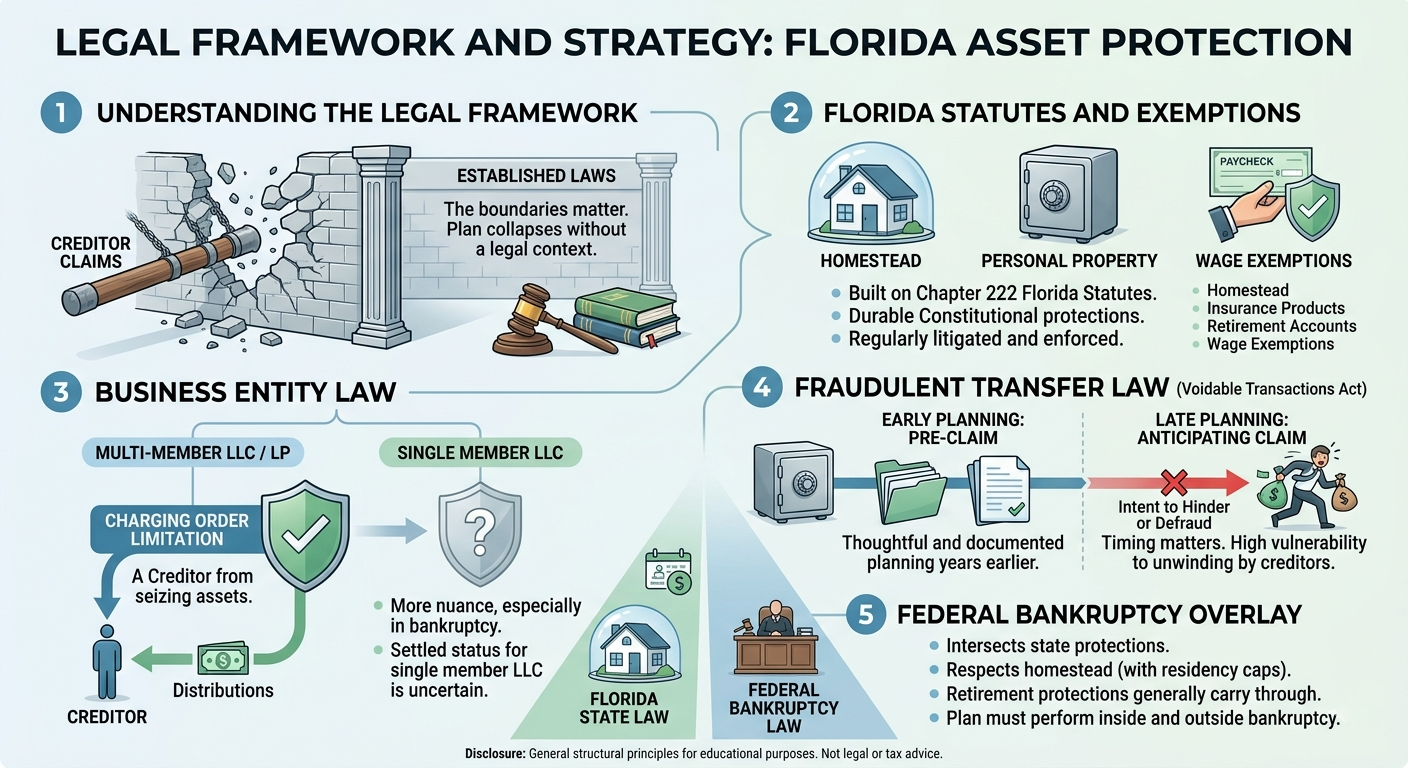

Legal Framework and Strategy: Florida Asset Protection
Understanding the legal framework behind asset protection in Florida is the difference between a plan that holds and one that collapses under scrutiny. The tools available under Florida law are genuine and well established, but they operate within a specific legal context that shapes what works and what does not.
This is not a space where creativity without boundaries is rewarded. The boundaries matter. Florida’s fraudulent transfer laws, judicial interpretation of exemptions, and federal overlay in bankruptcy proceedings all affect how a protection strategy performs in practice.
Florida Statutes and Exemptions
Florida’s asset protection framework is built primarily on Chapter 222 of the Florida Statutes, which governs the exemption of property from forced sale. This chapter covers homestead protections, personal property exemptions, wage exemptions for heads of household, and protections for insurance products and retirement accounts. These provisions are not advisory; they carry real legal force and are regularly litigated and enforced.
The Florida Constitution’s homestead provision adds a layer of durability to residential property protections that statutes alone cannot provide. Constitutional protections are harder to change, which gives long-term planners a degree of confidence in building around them.
Business Entity Law
Florida’s LLC Act and limited partnership statutes provide the structural tools most commonly used in asset protection planning, aside from individual exemptions. The charging order limitation under Florida law is an important feature for multi-member LLCs and limited partnerships. It restricts a creditor of an individual member or partner from receiving distributions when and if they are made, rather than allowing the creditor to step into the ownership role or force a sale of the entity.
Single member LLCs present a more nuanced picture. Florida courts and federal courts sitting in Florida have at times treated single member LLCs differently, particularly in bankruptcy contexts. The strength of charging order protection for a single member entity is not as settled as it is for multi member structures, and planning around this distinction is a practical consideration for anyone using an LLC as a primary vehicle.
Fraudulent Transfer Law and Its Implications
Florida’s Uniform Fraudulent Transfer Act, now replaced by the Uniform Voidable Transactions Act, sets the rules for when a transfer of assets can be unwound by a creditor. The critical concepts are insolvency at the time of transfer, whether the transfer was made with intent to hinder, delay, or defraud a creditor, and the timing relative to when a claim arose or was reasonably foreseeable.
This body of law is why timing matters so much in asset protection. A transfer made in anticipation of a specific claim, particularly if it leaves the transferor insolvent, is highly vulnerable. A transfer made years earlier as part of a thoughtful and documented planning process is in an entirely different position. Strategy must account for this distinction at every stage.
Federal Bankruptcy Overlay
Federal bankruptcy law intersects with Florida’s state law protections in ways that can either reinforce or complicate a plan. Florida’s homestead exemption, for example, is generally respected in bankruptcy, though federal law caps the amount that can be exempted if the debtor has not been a Florida resident for a sufficient period before filing. Retirement account protections also carry through into bankruptcy to a significant degree under federal exemptions.
For clients with significant exposure or complex situations, understanding how a plan performs both outside and inside a potential bankruptcy proceeding is part of a thorough analysis. State law planning and federal bankruptcy law are not always aligned, and a strategy that works well in one context may face different treatment in the other.
Disclosure: The information in this article reflects general structural principles and practical observations from consulting experience and is provided for educational purposes only. It should not be interpreted as individualized legal or tax advice.
Expand your knowledge of asset protection, business planning, taxation, and private trusts. Explore the available books on Amazon.