
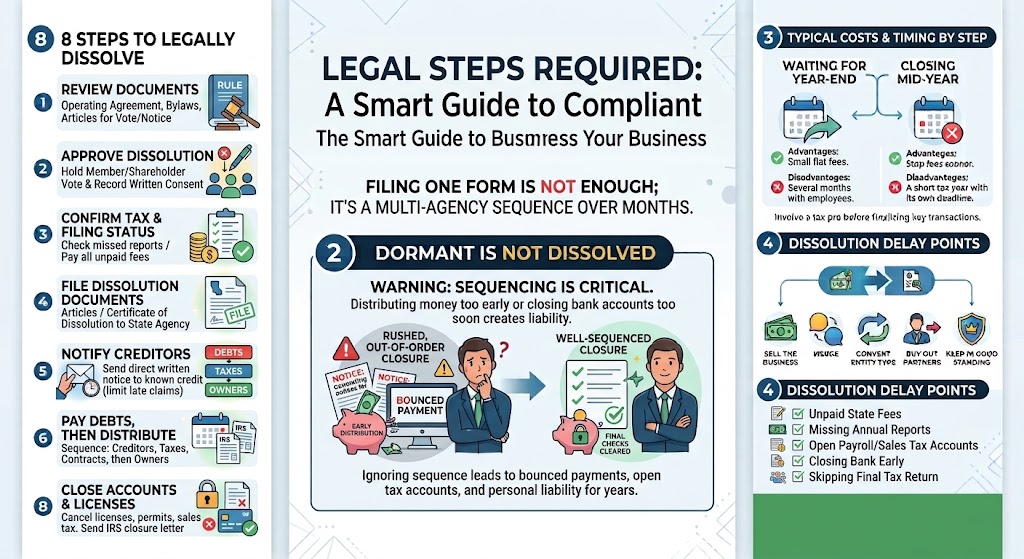

Legal Steps Required
Filing one form is not the same as closing a business.
Many owners believe dissolution means submitting a single document to the Secretary of State. In reality, a compliant closure is a sequence involving several agencies and, in most cases, several months. State filings, tax filings, creditor communication, and account closures all have to happen, and the order matters. Closing a bank account too early can bounce final payments. Distributing money too early can create claims against owners. Skipping a final tax return can leave an account open indefinitely, generating notices for years.
Requirements differ by state and by entity type, but the path below reflects how most compliant dissolutions unfold, along with the practical detail that owners tend to overlook at each step.
Step 1: Review The Governing Documents
Start with the operating agreement for an LLC, or the articles and bylaws for a corporation. These documents set the required vote, notice periods, the winding up process, and how assets are distributed. If your agreement is silent on a point, state law fills the gap, and those defaults may not match what the owners originally assumed. For multi member entities, check whether a supermajority or unanimous vote is required, and whether any member has a contractual right to object or delay.
Step 2: Approve The Dissolution
Hold the required member or shareholder vote and record it in writing. Meeting minutes or a signed written consent both work in most situations. This document becomes the foundation of your paper trail, and it is often the first thing requested if a dispute or audit arises later. Keep a signed, dated original, and store copies in more than one place.
Step 3: Confirm Tax And Filing Status
Some states require tax clearance or proof of good standing before they accept dissolution paperwork, and franchise taxes are generally expected to be paid through the date of closure. Catching missed annual reports or unpaid fees early prevents rejections and delays that can stretch a simple filing into a months long back and forth with the state.
Step 4: File Dissolution Documents
Depending on the state, the filing may be called Articles of Dissolution, a Certificate of Dissolution, or a Certificate of Cancellation. Some states use a two stage process: first a filing that begins the wind down, then a final cancellation once obligations are settled. Confirm which applies in your state, because filing only the first stage may leave the entity technically active and still subject to annual fees.
Step 5: Notify Creditors And Claimants
Many states offer a formal notice process with deadlines for creditors to submit claims. Direct written notice to known creditors, and in some states published notice for unknown claimants, can limit how long after closing a claim can be brought against the owners. Where this process is optional, using it anyway is generally a smart protective step, since it starts a clock that eventually closes the door on late claims.
Step 6: Pay Debts, Then Distribute Assets
The order here is critical, and it is the single most common source of post dissolution liability. Creditors, taxes, and contract obligations come first. Only after those are settled are remaining assets distributed to owners according to the operating agreement or ownership percentages. Owners who distribute funds first and pay creditors later can be personally ordered to return the distributions.
Step 7: File Final Tax Returns
- Single member LLCs generally report the final year on the owner’s personal return, with employment taxes filed separately if the business had employees
- Partnerships and multi member LLCs check the final return box on the partnership return and issue final owner tax statements
- Corporations file a final corporate return and generally file Form 966 within 30 days of adopting a resolution to dissolve
- Employers file final employment tax returns and provide final wage and contractor forms to workers
- Asset sales may require Form 8594 to report how the purchase price was allocated among the assets sold
The IRS outlines these requirements on its Closing a Business page at irs.gov, and because entity classification affects the exact list of forms, it is worth confirming the details with a tax professional before the final return is filed.
Step 8: Close Accounts And Licenses
Cancel business licenses, permits, sales tax accounts, assumed names, and the registered agent appointment. Send the IRS a written request to close the business account, including the legal name, EIN, business address, and reason for closing. Close the bank account last, once every payment has cleared, including any checks that may still be outstanding.
A Note On The EIN
The IRS does not cancel or reassign EINs. The closure letter ends the business account, and it should follow the filing of final returns, not come before them, since the account needs to remain open long enough to receive any correspondence tied to those filings.
Typical Costs And Timing By Step
State filing fees for dissolution paperwork are typically modest, often in the range of a small flat fee, though some states charge more for corporations than for LLCs. Tax clearance, when required, can add weeks to the timeline if the state has a backlog. Creditor notice periods are often set by statute and can run from a few weeks to a few months. Altogether, a simple, debt free entity can often be closed within four to eight weeks, while an entity with employees, debts, or multiple owners should plan for two to six months.
Where Dissolutions Get Delayed
- Unpaid state fees or missing annual reports
- Name or address mismatches on filings
- Missing signatures or an undocumented owner vote
- Open payroll or sales tax accounts
- Closing the bank account too early
- Skipping the final return because there was no income that year
Frequently Asked Questions
Q: Do I need an attorney to dissolve an LLC?
Simple closures can sometimes be handled without one, but debts, disputes, multiple owners, and tax issues make professional support valuable, particularly where a formal creditor notice process is involved.
Q: What if I already stopped operating months ago?
You still need to complete the formal steps described above. Stopping operations does not end the entity’s legal existence or its filing obligations.
Q: Will the state notify me when it is finished?
Most states issue a filing confirmation or certificate once the dissolution is accepted. Keep it permanently with your other formation records.
Q: What happens if a creditor surfaces after the notice period has closed?
In states with a formal claims process, a properly noticed and expired claims period can bar late claims, which is one of the strongest reasons to use that process even when it is optional.
Get the sequence right. Acacia Management prepares and files your dissolution documents, coordinates state and federal requirements, and helps you sequence every step. Contact us to get started with business dissolution services.
Expand your knowledge of asset protection, business planning, taxation, and private trusts. Explore the available books on Amazon.