

Michigan Asset Protection Strategy
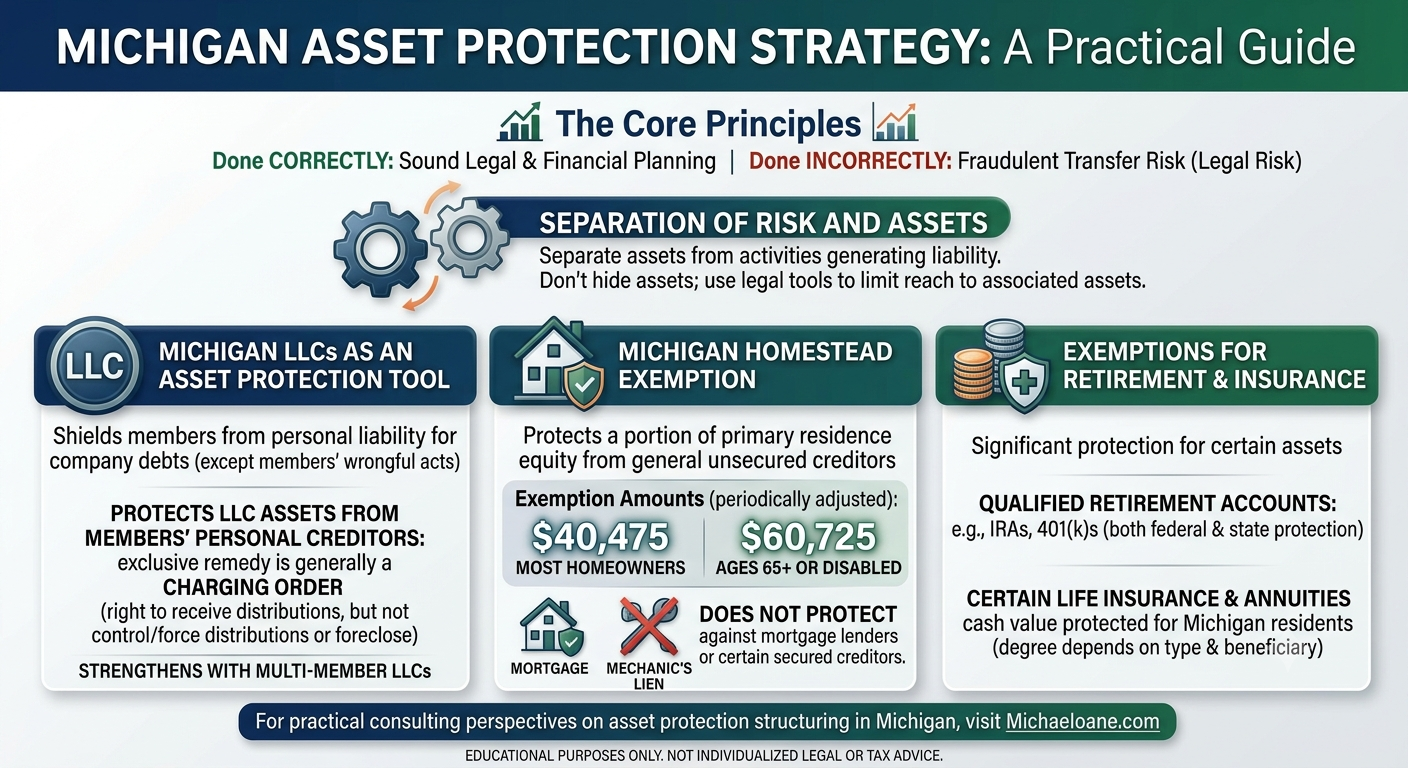
Asset protection planning in Michigan is a practical discipline, not a specialty reserved for the very wealthy or for people who already have lawsuits pending. It is a set of structuring decisions made before problems arise that determine which assets are reachable by creditors and which are not. Done correctly, it reflects sound legal and financial planning. If done incorrectly or after the fact, it can constitute a fraudulent transfer and expose the planner to additional legal risk.
This article provides an overview of how asset protection strategy works in Michigan, what the legal framework looks like, which tools are commonly used, and where the real limits of protection lie under Michigan law.
The Foundation: Separation of Risk and Assets
The central principle behind asset protection planning is the separation of assets from the activities that generate liability. A business owner who holds valuable real estate, investment accounts, and business equipment all in their own name has concentrated both the upside and the exposure in a single legal person. A successful lawsuit, a business debt, or a personal liability event can affect everything.
The structural approach to asset protection distributes that exposure. Operating businesses are placed in entities that limit personal liability. Assets that are not part of active business operations are held separately from those that are. The goal is not to hide assets or defraud anyone; it is to use the legal tools available to limit the reach of any single liability event to the assets appropriately associated with it.
Michigan law provides several tools for accomplishing this separation, including limited liability companies, limited partnerships, and irrevocable trust structures. Each has distinct characteristics regarding the protection it provides, the tax treatment it receives, and the operational requirements it imposes.
Michigan LLC as an Asset Protection Tool
The Michigan Limited Liability Company Act provides for the formation of LLCs that offer liability protection to their members. A properly formed and maintained Michigan LLC shields its members from personal liability for the LLC’s debts and obligations, with the important caveat that members can still be personally liable for their own wrongful acts, including torts they commit while acting on behalf of the company.
Michigan LLCs also offer a form of protection that runs in the other direction: protection of the LLC’s assets from its members’ personal creditors. Under Michigan law, a creditor of an LLC member who obtains a judgment against that member is generally limited to a charging order as the exclusive remedy against the member’s interest in the LLC. A charging order gives the creditor the right to receive distributions that the LLC makes to the debtor member, but it does not give the creditor the right to force distributions, to take control of the LLC, or to foreclose on the member’s interest.
The charging order limitation is a meaningful protection, but it should not be overstated. Michigan courts have discretion in equity, and the exclusivity of the charging order remedy has been interpreted and applied differently in different factual contexts. The protection is strongest in a multi-member LLC where forcing distributions or foreclosing on the interest would harm other members; it is potentially weaker in a single-member LLC where there are no other members whose interests would be affected.
Homestead Exemption in Michigan
Michigan provides a homestead exemption that protects a portion of a resident’s equity in their primary residence from the claims of general unsecured creditors. The Michigan homestead exemption amount is $40,475 for most homeowners and $60,725 for homeowners who are 65 years of age or older or who are disabled. These amounts are adjusted periodically.
The homestead exemption does not protect against all creditors. Mortgage lenders, mechanics lienholders, and certain other secured creditors retain their rights against the property regardless of the exemption. The exemption applies against unsecured judgment creditors. For Michigan residents with significant home equity above the exemption amount, the unprotected equity is accessible to judgment creditors, a relevant consideration in broader asset protection planning.
Michigan Exemptions for Retirement Accounts and Insurance
Michigan law provides significant protection for certain categories of assets beyond the homestead. Qualified retirement accounts, including IRAs, 401(k) plans, and similar tax-qualified plans, are generally protected from the claims of creditors under both federal law and Michigan exemption statutes, subject to limits on IRAs established by the Bankruptcy Abuse Prevention and Consumer Protection Act.
Michigan also provides exemptions for certain life insurance and annuity products. The cash value of life insurance policies owned by Michigan residents is protected to a meaningful degree, though the specifics depend on the type of policy and the beneficiary’s identity. These statutory exemptions represent a baseline of asset protection that exists regardless of additional planning, and they should be accounted for in any comprehensive strategy.
Michigan asset protection strategy is built on a clear understanding of what the law actually provides, where the gaps are, and which tools are appropriate for the specific situation. For practical consulting perspectives on asset protection structuring in Michigan and other jurisdictions, visit MichaelIoane.com.
The information in this article reflects general structural principles and practical observations from consulting experience and is provided for educational purposes only. It should not be interpreted as individualized legal or tax advice.
Expand your knowledge of asset protection, business planning, taxation, and private trusts. Explore the available books on Amazon.