

Nevada Self-Directed IRA
Nevada has become one of the more practical jurisdictions for investors who want to hold alternative assets inside a retirement account. A self-directed IRA structured in Nevada gives the account holder meaningful flexibility, particularly when the investment strategy involves real estate, private equity, or other non-traditional holdings that a standard brokerage custodian simply will not accommodate.
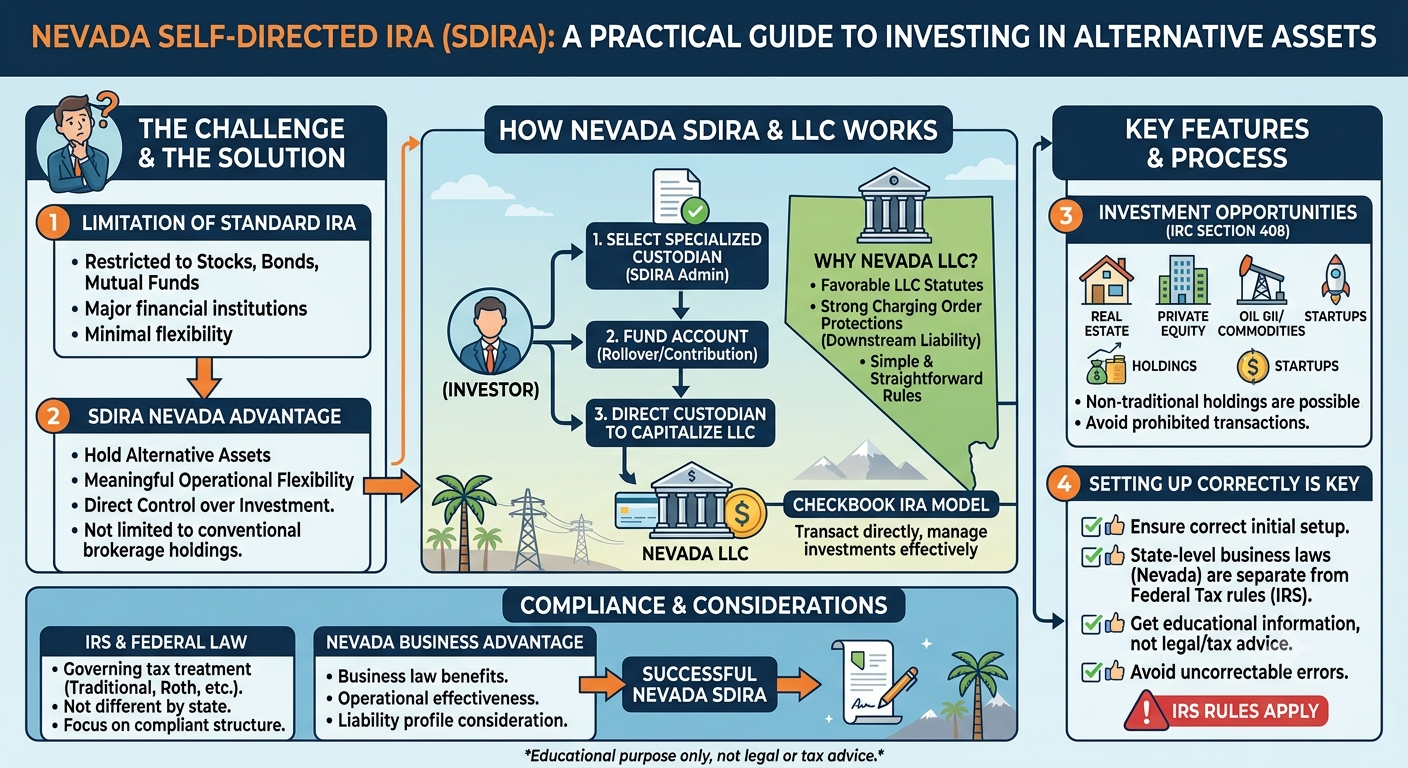
What distinguishes a self-directed IRA Nevada structure from the conventional variety is not the tax treatment; that remains governed by federal law regardless of the state. The difference lies in what the account can hold and how that is managed. A standard IRA through a major financial institution is limited to stocks, bonds, and mutual funds. A self-directed IRA expands that universe considerably, to the extent permitted under IRC Section 408 and IRS guidelines on prohibited transactions.
Why Nevada Comes Up in This Conversation
Nevada is frequently mentioned in discussions of self-directed IRA structures because of the state’s favorable treatment of LLCs, which are often used as the investment vehicle under an IRA. When a self-directed IRA owns an LLC that holds the actual assets, the investor gains a layer of operational flexibility that holding assets directly in the custodial account does not provide. Nevada’s LLC statutes are straightforward and offer strong charging order protections, making the state a reasonable choice for investors who are also considering the downstream liability profile of their structure.
That said, the state of formation matters less than people sometimes assume. The IRS does not treat Nevada-formed entities differently from those formed in Wyoming, Delaware, or any other state for purposes of IRA compliance. The state-level advantages are real in terms of business law; they are simply separate from the federal tax question.
What Investors Are Actually Looking For
Most investors who ask about a self-directed IRA Nevada structure are trying to solve a specific problem. They want to use retirement funds to invest in something their current custodian does not allow, and they want to do it in a way that gives them more direct control over the investment decision without triggering a taxable distribution.
The setup typically involves selecting a custodian that specializes in self-directed accounts, funding the account through a rollover or direct contribution, and then directing the custodian to invest in an approved asset or to capitalize an LLC owned by the IRA. From there, the LLC can open a bank account and transact directly, which is the operational core of what is often called the checkbook IRA model.
For investors active in Nevada real estate or those with Nevada-based business interests, forming the LLC in Nevada and housing it inside a self-directed IRA is a natural fit. The key is making sure the structure is set up correctly from the beginning, because errors in this area are not easily corrected after the fact.
Disclosure
The information in this article reflects general structural principles and practical observations from consulting experience and is provided for educational purposes only. It should not be interpreted as individualized legal or tax advice.
Expand your knowledge of asset protection, business planning, taxation, and private trusts. Explore the available books on Amazon.