

Self-Directed IRA in Nevada
Investors who want to use retirement capital to acquire real estate, fund private placements, or hold assets outside the public markets increasingly look at the self-directed IRA as a practical vehicle. Setting up a self-directed IRA in Nevada is a common option, particularly for investors who already have business ties to the state or want to take advantage of Nevada’s business-friendly LLC laws as part of a broader retirement planning strategy.
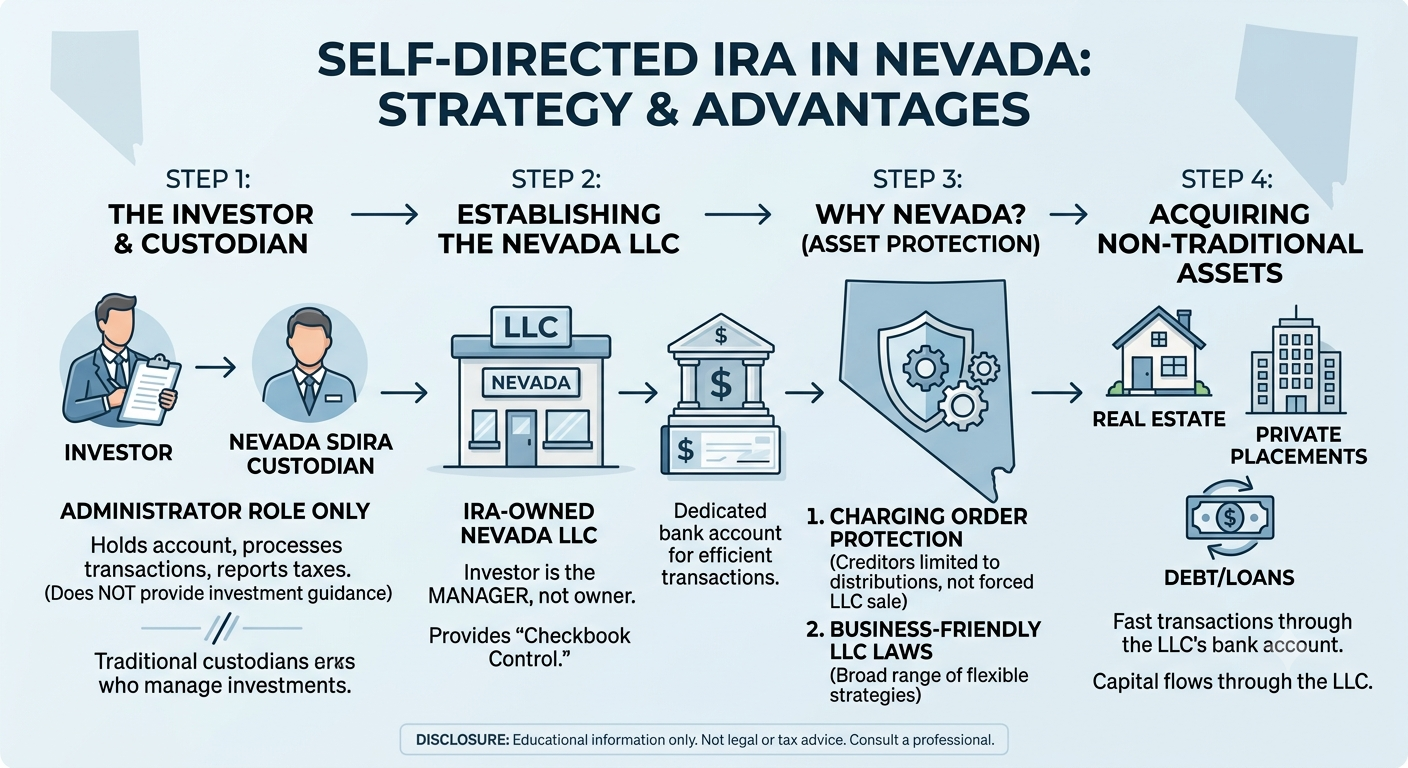
It is worth being clear about what the phrase actually means. Any IRA is, in a technical sense, self-directed; the investor makes the decisions. What the market has come to mean by the term is an IRA held with a custodian that permits non-traditional investments, combined with a structure that gives the account holder more direct involvement in managing those investments. That structure, in many cases, is a Nevada LLC owned entirely by the IRA.
The Custodian Relationship
Every IRA requires a custodian. That is a requirement of federal tax law, not a structural preference. The difference with a self-directed account is that the custodian’s role is administrative rather than advisory. The custodian holds the account, processes transactions, and issues the required tax reporting, but it does not screen investments for suitability or provide investment guidance.
For investors building a self-directed IRA in Nevada, selecting the right custodian is one of the more consequential early decisions. Not all self-directed custodians accept the same asset types, and their fee structures vary considerably. Some specialize in real estate; others have more experience with private equity or notes. It is worth taking the time to match the custodian to the intended investment strategy rather than defaulting to the first name in search results.
The Nevada LLC Component
When the self-directed IRA holds a Nevada LLC, the investor becomes the manager of that LLC without being the owner. Ownership sits with the IRA. This is an important distinction because the prohibited transaction rules under IRC Section 4975 restrict certain dealings between the IRA and disqualified persons, which include the account holder, their family members, and entities they control in a personal capacity.
Nevada’s charging order protection is one reason the state is popular for this structure. If a creditor obtains a judgment against the LLC manager personally, Nevada law limits the creditor’s remedy to a charging order against distributions rather than allowing a forced sale of LLC membership interests. This does not override IRS rules, but it does add a layer of structural protection at the state level that many investors find useful.
The LLC also allows the IRA to hold a dedicated bank account and transact with reasonable efficiency. Rather than routing every investment through a custodian approval process, the manager can act on the LLC’s behalf within the boundaries the IRS permits. That operational speed matters in real estate transactions, particularly where timing can determine whether a deal closes.
Disclosure
The information in this article reflects general structural principles and practical observations from consulting experience and is provided for educational purposes only. It should not be interpreted as individualized legal or tax advice.
Expand your knowledge of asset protection, business planning, taxation, and private trusts. Explore the available books on Amazon.