

Ultimate Guide to North Carolina Trust Structuring Compliance
However, In North Carolina, Trust structuring matches the right vehicle to a client’s goals.
Additionally, it also preserves the legal integrity of the structure over time.
Moreover, Strategy without compliance is an on-paper plan that fails in practice.
Furthermore, Compliance without strategy maintains a structure but may neglect the client’s needs.
This article covers two dimensions.
Additionally, it explains the strategic considerations that drive the selection of Trust structures in North Carolina.
It also outlines the compliance obligations needed to keep the structure functioning as intended.
Matching Trust Type to Planning Objectives
The starting point in North Carolina Trust strategy is to have a clear understanding of what the arrangement must accomplish.
Additionally, different objectives call for different structures, building Trust.
However, using the wrong vehicle undermines Trust and creates inefficiencies or gaps in protection that may appear when needed.
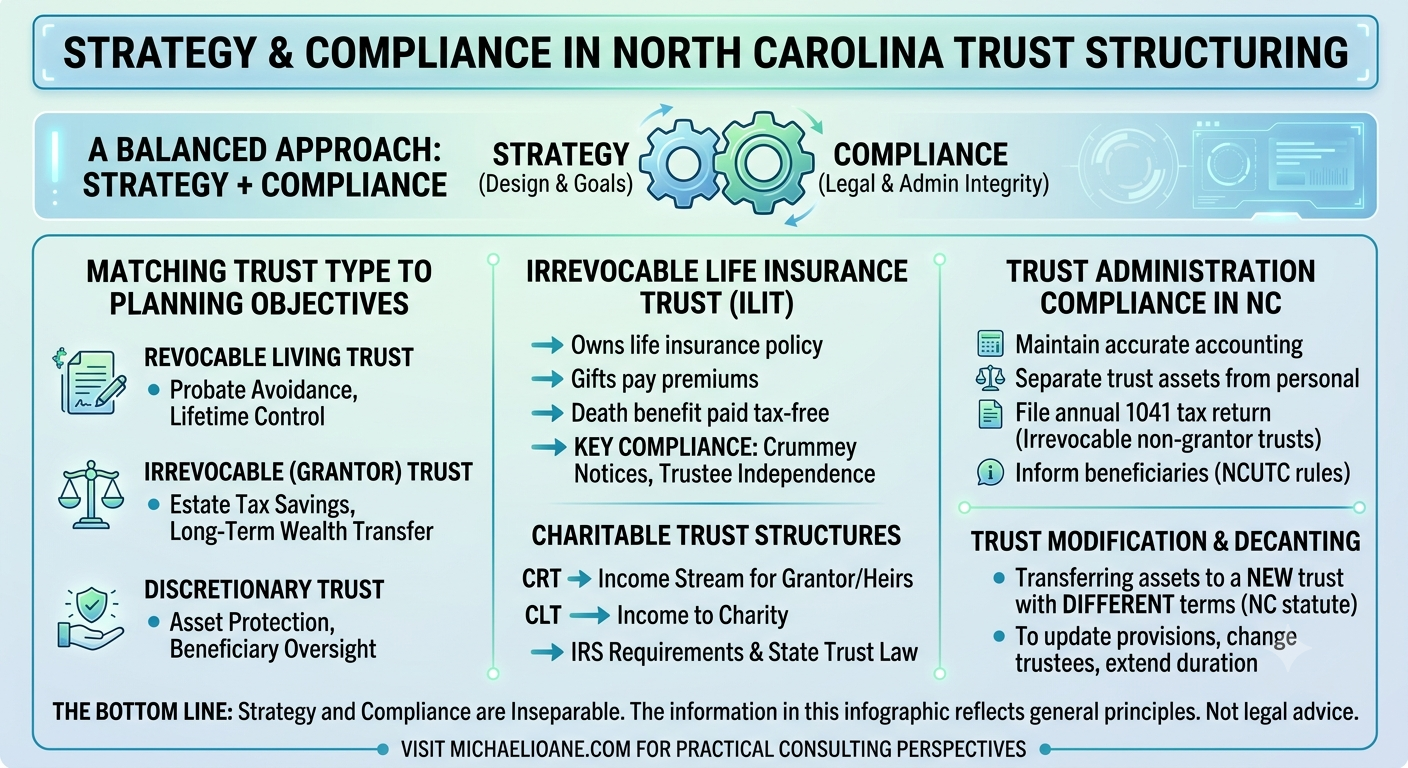
For probate avoidance and simplified estate administration, a revocable living Trust is often the right tool.
Additionally, it allows the granter to maintain control during their lifetime. It avoids the public and potentially slow North Carolina probate process. It can be coordinated with a pour-over will to capture assets not transferred to the Trust before death.
However, it provides no creditor protection during the granter’s lifetime, but it is not intended to affect Trust.
For long-term wealth transfer to children or grandchildren, minimize estate and gift tax exposure within a Trust. An irrevocable granter arrangement for income tax purposes may be appropriate. In a granter structure, the granter pays income tax on the earnings. The assets stay outside the granter’s taxable estate. The granter’s payment of income tax is effectively a tax-free gift to the arrangement. This lets the assets grow without being depleted by income taxes at the arrangement level.
For beneficiaries who need asset management but have creditor exposure or limited financial sophistication, a discretionary Trust provides protection. With a professional trustee and spendthrift provisions, it also ensures oversight. The trustee’s discretion insulates assets from creditors and from a beneficiary’s missteps.
Irrevocable Life Insurance Trusts
One of the more commonly used irrevocable trust structures in North Carolina estate planning is the irrevocable life insurance trust, referred to as an ILIT. The ILIT owns a life insurance policy on the granter’s life, so that the death benefit is paid to the trust rather than to the granter’s estate. Because the granter does not own the policy, the death benefit is generally not included in the granter’s taxable estate.
The ILIT is funded through annual gifts from the granter to the trust.
Additionally, the trust uses these gifts to pay the insurance premiums.
To qualify for the annual gift tax exclusion, the beneficiaries must have a limited right to withdraw the gifted amounts.
This mechanism is known as a Crummey power.
The technical requirements for a valid ILIT include proper Crummey notices.
Furthermore, they also require trustee independence from the granter to ensure the structure functions as intended.
Charitable Trust Structures in North Carolina
North Carolina residents who want to achieve charitable and personal financial goals sometimes use charitable vehicle structures.
A charitable remainder Trust lets the granter transfer appreciated assets, claim a tax deduction, and receive income stream for life.
The remainder passes to charity.
A charitable lead arrangement works in reverse: the charity receives income first, and the remainder passes to the granter’s heirs.
These structures involve specific IRS requirements for the trust’s form and the calculation of the charitable and non-charitable components. North Carolina follows the federal tax rules applicable to charitable trusts, and the trust document must be drafted to comply with both federal tax requirements and state trust law.
Trust Administration Compliance in North Carolina
Once a North Carolina trust is established, the compliance obligations begin.
Additionally, the trustee must administer the trust in accordance with its terms and with the NCUTC’s default rules.
Key compliance obligations include maintaining accurate trust accounting records.
Keep trust assets separate from the trustee’s personal assets.
Make distributions in accordance with the trust’s terms and the trustee’s fiduciary duties.
File the trust’s annual income tax return on Form 1041 for irrevocable trusts that are not granter trusts.
Provide beneficiaries with the information they are entitled to receive under the NCUTC and the trust document.
North Carolina irrevocable trusts that are not granter trusts are taxed as separate entities for federal income tax purposes.
They are taxed for state income tax purposes as well.
Additionally, Trustees must account for both the federal and North Carolina tax obligations annually.
Trust Modification and Decanting
Circumstances change after a Trust is established, and a document that was well-suited at drafting may become less appropriate.
Moreover, North Carolina law provides mechanisms to modify an irrevocable instrument, including consent of interested parties, court order, and decanting.
North Carolina enacted its decanting statute as part of the NCUTC framework.
The statute allows a trustee with discretionary distribution authority to distribute trust assets to a new trust.
Moreover, this is subject to certain requirements.
Decanting can update administrative provisions.
It can change trustee succession, add or modify spendthrift protections, or extend the trust’s duration.
The specific requirements for valid decanting in North Carolina must be carefully followed.
Trust strategy and compliance in North Carolina are inseparable.
Moreover, the strategic design determines what it can accomplish.
The compliance framework then decides whether it continues to accomplish those objectives over time.
Both deserve careful attention from the outset.
For practical consulting perspectives on structuring strategy, visit MichaelIoane.com.
The information in this article reflects general structural principles. It provides practical observations from consulting experience and is for educational purposes only.
It should not be interpreted as individualized legal or tax advice.
Expand your knowledge of asset protection, business planning, taxation, and private trusts. Explore the available books on Amazon.