

Structuring a Business in Colorado
When someone asks how to structure a business in Colorado, the question usually contains several smaller questions that need to be answered first. What kind of liability protection is actually needed? How will the business be taxed? Who else is involved, and how should ownership and control be allocated? What happens if a dispute arises between owners or between the business and a third party?
The structure chosen at formation answers all of these questions, at least in the initial framework. Getting it right from the beginning is far easier than correcting it after the business has been running for a year or two, when unwinding and restructuring often trigger tax consequences and require agreement from multiple parties.
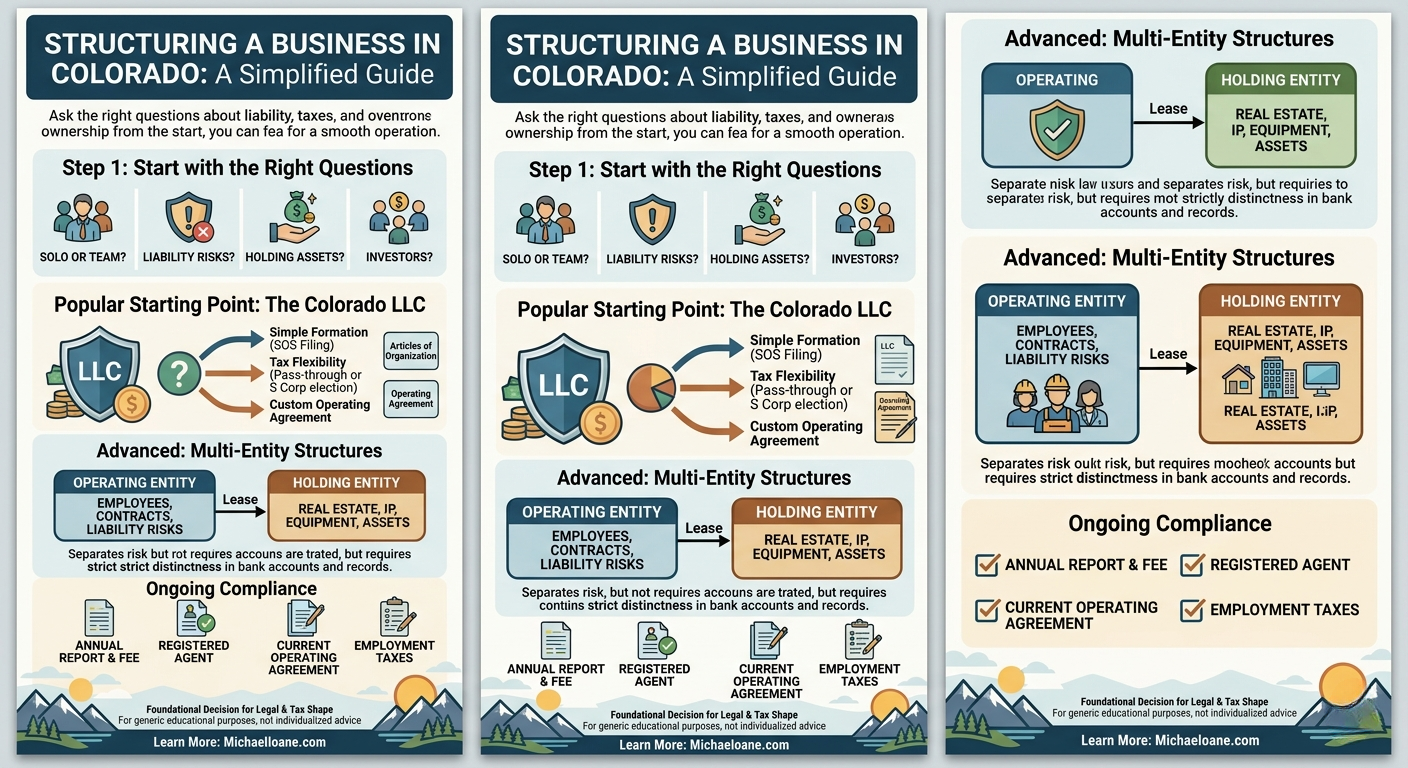
Starting with the Right Questions
Before selecting an entity, type or filing anything with the Colorado Secretary of State, it is worth working through a basic set of planning questions. These include: Is this a solo operation or a multi-member venture? Does the business carry physical or professional liability risk? Will the business hold real estate or other assets that should be separated from operating risk? Are there investors involved who expect a particular equity structure? Will the business need to raise capital in ways that require a corporation rather than an LLC?
The answers to those questions narrow the options considerably. A solo consultant with no employees and minimal liability exposure has very different structural needs than a construction company with subcontractors and physical job sites or a real estate operator holding multiple rental properties.
The Colorado LLC as a Starting Point
For most small and midsize businesses, a Colorado LLC is the right starting point. It is simple to form, inexpensive to maintain, and offers a default tax treatment that avoids entity-level federal income tax. Members report their share of income and loss on their personal returns, which is generally preferable to corporate double taxation for businesses that are distributing profits to their owners.
Colorado LLCs are formed by filing Articles of Organization with the Secretary of State and paying a nominal fee. More substantive work occurs during drafting the operating agreement, which governs the relationship among members and establishes the company’s internal rules. Colorado law gives members broad latitude to customize the operating agreement, including provisions for buy-selling arrangements, dispute resolution, and restrictions on the transfer of membership interests.
Multi-Entity Structures
More complex businesses, or those operating in higher-risk industries, frequently use a multi-entity structure rather than a single LLC. A common arrangement involves one entity that holds assets (real estate, intellectual property, equipment) and a separate entity that operates the business and takes on liability exposure. The operating entity enters contracts, employs workers, and faces the world; the holding entity owns the valuable assets and leases them to the operating entity.
This kind of separation does not eliminate liability, but it can limit exposure of assets held outside the operating entity. If the operating company is sued and a judgment is obtained, the plaintiff has a claim against the operating entity, not the holding entity, provided the two are genuinely separate and not being treated as one.
Colorado courts will look at whether the entities are actually maintained as distinct, including whether they have separate bank accounts, recordkeeping, and management decisions. The structure provides the protection it promises only if it is operated properly.
Compliance After Formation
Forming the entity is step one. Maintaining it is the ongoing obligation. Colorado requires LLCs to file an annual report with the Secretary of State and pay the associated fee. Failure to file can result in delinquent status and, eventually, administrative dissolution, which eliminates the liability protection the entity provided.
Beyond the state filing, compliance also includes maintaining a registered agent with a Colorado address, keeping a current operating agreement, and, for businesses with employees, meeting all state and federal employment tax obligations.
Structuring a business in Colorado is a foundational decision that shapes the legal and tax environment of the operation from day one. Working through those decisions with attention to the business’s actual facts, rather than generic templates, produces a structure that serves its intended purpose. For additional guidance, visit MichaelIoane.com.
The information in this article reflects general structural principles and practical observations from consulting experience and is provided for educational purposes only. It should not be interpreted as individualized legal or tax advice.
Expand your knowledge of asset protection, business planning, taxation, and private trusts. Explore the available books on Amazon.