
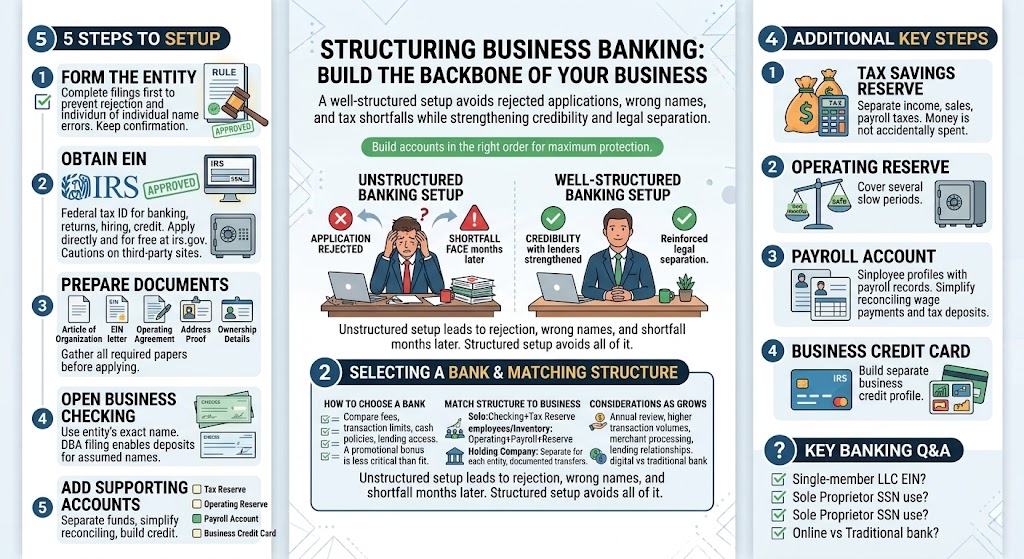

Structuring Business Banking
Your bank accounts are the backbone of your business. Build them in the right order.
Setting up business banking looks simple, and yet it is where many new entities lose weeks. Applications are rejected because the entity was not fully formed. Accounts are opened under the wrong name. Owners skip the tax reserve and face a shortfall months later. A well structured setup avoids all of it, and it also strengthens your credibility with lenders and reinforces the legal separation between you and your company.
This article walks through the correct order of operations, what documents to prepare in advance, how to choose a bank, and how the right structure changes as a business grows.
Step 1: Form The Entity
Banks need proof that your entity legally exists. Complete the state filing first and keep the confirmation. Applying before formation is complete is one of the most common causes of rejection, and it can also result in an account being opened incorrectly under an individual’s name rather than the entity’s.
Step 2: Obtain Your EIN
The Employer Identification Number is your business’s federal tax ID, used to open bank accounts, file tax returns, hire employees, and apply for business credit. The IRS issues it at no cost through its online EIN application at irs.gov.
- The application is free when submitted directly to the IRS
- The online process requires the responsible party to be an individual with a Social Security number or ITIN
- The name on the application should match your formation documents exactly, including punctuation and suffixes like LLC or Inc
- Applicants without an SSN or ITIN may need to apply by phone, fax, or mail instead of online
- Save the confirmation letter, because banks commonly ask for it and it can take time to obtain a replacement
Be cautious of third party websites that charge for something the IRS provides free. If you want professional support with accuracy, complex ownership structures, or foreign owners, choose an EIN service that is transparent about its fees and explains exactly what it does on your behalf.
Step 3: Prepare Your Documents
- Formation documents such as Articles of Organization or Incorporation
- The EIN confirmation letter
- The operating agreement or bylaws
- Government issued ID for each owner and signer on the account
- Proof of business address, such as a utility bill or lease
- Ownership details for individuals with significant interest in the entity
Step 4: Open A Dedicated Business Checking Account
Open the account in the exact legal name of the entity. If you operate under an assumed name, bring the DBA filing so the bank can set up the account correctly and so payments made out to the assumed name can be deposited without issue.
Step 5: Add Supporting Accounts
- Tax reserve savings for income, sales, and payroll taxes, kept separate so the money is not accidentally spent
- Operating reserve to cover several months of expenses during slow periods
- Payroll account if you have employees, which simplifies reconciling wage payments and tax deposits
- Business credit card for business spending and for building a business credit profile separate from your personal credit
How To Choose A Bank
Compare monthly fees, minimum balances, transaction limits, cash deposit policies, wire and ACH costs, accounting software integrations, and access to lending. A promotional bonus matters far less than whether the account fits how you operate. Businesses that handle heavy cash or high transaction volume in particular should read the fee schedule closely, since per transaction fees can add up quickly once volume increases.
Match The Structure To The Business
A solo consultant may need one checking account and one tax reserve, and nothing more complicated than that. A business with employees and inventory may need operating, payroll, and reserve accounts to keep each function separate and easy to track. A holding company structure may need separate accounts for each entity, with documented transfers between them, so that money moving between related companies is clearly recorded rather than blended together.
Considerations As The Business Grows
As revenue and balances increase, additional questions become relevant: whether a single bank can support higher transaction volumes without excessive fees, whether balances exceed standard deposit insurance limits and need to be spread across institutions, and whether the business has outgrown a purely digital bank in favor of one with treasury management services, merchant processing, and lending relationships. Revisiting the banking structure once a year, or after any significant change in revenue, is a reasonable habit to build in.
Frequently Asked Questions
Q: Can I open an account with just my Social Security number?
That is a sole proprietor setup. If you formed an entity, the account should use the entity’s name and EIN instead, to keep the legal separation intact.
Q: Do I need an EIN for a single member LLC?
Generally yes for banking and most business purposes, and it is required if you have employees, even though the IRS does not always require one for tax filing purposes alone.
Q: Can I get an EIN without a Social Security number?
Yes, through alternative application methods such as phone, fax, or mail. Foreign owners often benefit from professional guidance to navigate this process correctly the first time.
Q: Should I use an online only bank or a traditional bank?
It depends on your needs. Online banks often have lower fees and faster account opening, while traditional banks may offer better in person support, cash handling, and lending relationships as the business grows.
Expand your knowledge of asset protection, business planning, taxation, and private trusts. Explore the available books on Amazon.