

Unlock Proven Investment Freedom with a Self-Directed IRA
Investment Control in Retirement Accounts
Self-Directed IRA in retirement planning
However, a Self-Directed IRA gives an account holder real control. This aspect is frequently misunderstood in retirement planning.
Therefore, this applies in a Self-Directed IRA.
Thus, for a Self-Directed IRA, you can maintain significant control.
However, if the structure is set up correctly, you won’t violate rules.
Additionally, a Self-Directed IRA paired with a Nevada LLC offers investors genuine operational control.
Moreover, it gives investors real oversight over asset management.
This structure is legal.
Moreover, it is well-documented in tax court cases and IRS guidance.
However, careful execution is required.
It must maintain its integrity.
This is what control actually looks like.
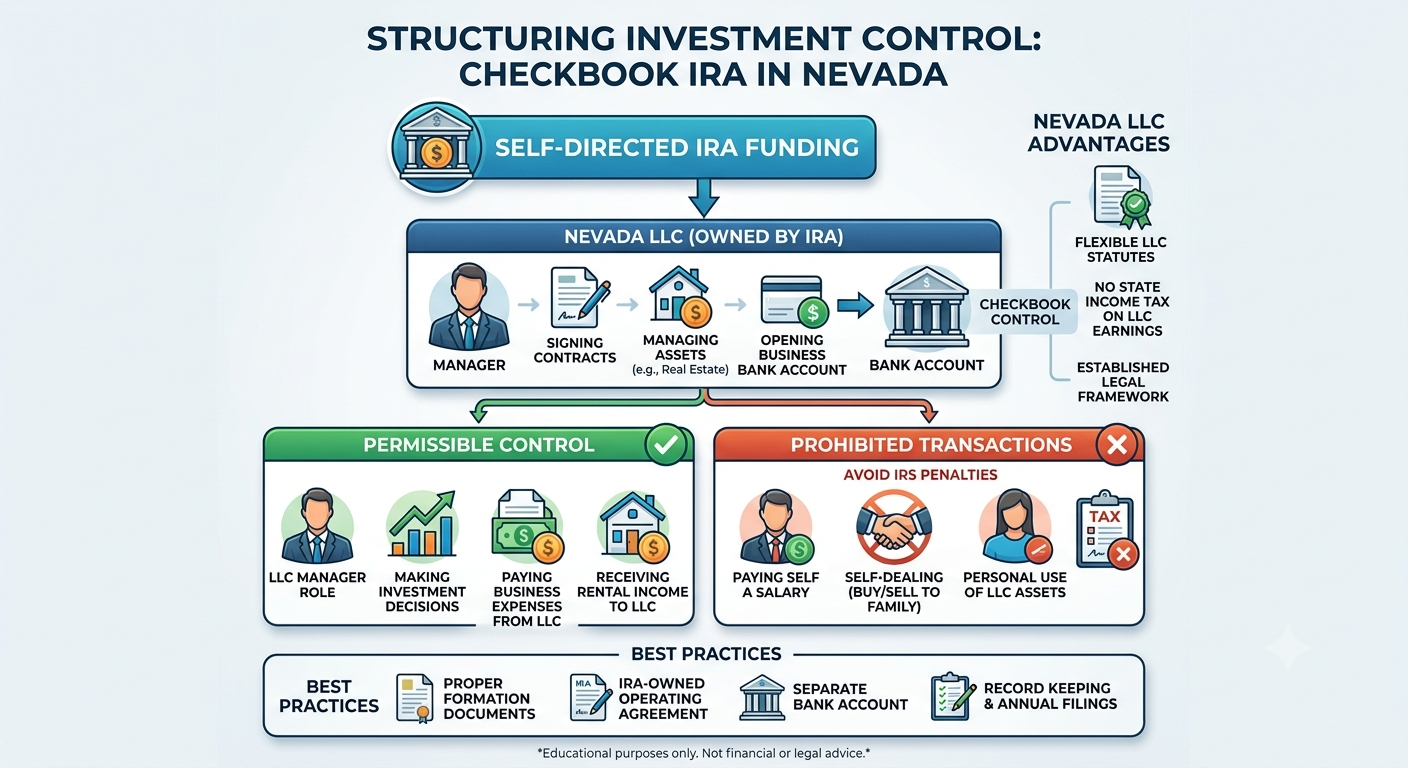
When a Self-Directed IRA forms, the account holder typically serves as the LLC manager.
Additionally, when it acquires a Nevada LLC, the account holder typically serves as the LLC manager.
Additionally, in that role, the manager can open a business bank account.
Moreover, they can sign contracts for the LLC.
Additionally, it allows investment decisions.
No custodian approval is needed for each transaction.
The manager cannot benefit personally from LLC activity in ways the IRS would classify as distributions.
Additionally, the IRA-owned LLC cannot pay the manager a salary.
Also, it cannot purchase property that the manager or a disqualified family member already owns.
Moreover, it cannot engage in transactions that primarily benefit the account holder.
These restrictions are not obscure technicalities.
Moreover, they are the central compliance concern in any self-directed IRA structure.
They are what differentiates a legitimate investment vehicle from an arrangement the IRS will disqualify.
A disqualified IRA is treated as if it distributed its entire balance on the first day of the year.
This creates an immediate and substantial tax liability.
Nevada as the LLC Jurisdiction
Nevada adds practical value in investment control because its LLC statutes are flexible. Its single-member LLC framework is clean. Additionally, Nevada imposes no state income tax on LLC earnings for passive income generated inside the structure.
Additionally, for real estate investors, a Self-Directed IRA can hold title to property through an IRA-owned Nevada LLC.
This arrangement also manages rental income.
Additionally, it supports transactions with its own bank account.
Moreover, the Nevada checkbook approach is not a workaround.
Additionally, this is an established planning strategy used by knowledgeable investors for years.
Additionally, we keep the structure clean.
The administrative discipline required to maintain a checkbook IRA structure is not trivial.
The LLC needs proper formation documents and an operating agreement that reflects IRA ownership.
It also requires a separate bank account used exclusively for IRA-related activities and careful record-keeping.
This keeps the LLC’s finances separate from the account holder’s personal finances.
Annual filings are part of maintaining the structure’s legitimacy.
Proper handling of UBIT (unrelated business income tax) when it applies is essential.
Consistent use of the LLC for its intended purpose supports legitimacy.
Investors who take shortcuts in these areas create risk.
That risk can undo the benefits of the strategy entirely.
Disclosure
The information in this article reflects general structural principles and practical observations from consulting experience.
Moreover, it is provided for educational purposes only and should not be interpreted as individualized legal or tax advice.
Expand your knowledge of asset protection, business planning, taxation, and private trusts. Explore the available books on Amazon.