

The Essential Ongoing Corporate Compliance Requirements
Ongoing corporate requirements
Liability protection makes corporations and LLCs attractive. It shields personal assets from business debts and lawsuits. This protection depends on maintaining the entity’s good standing.
Courts and creditors can pierce the corporate veil more easily. This occurs if a business is administratively dissolved or ignores formalities.
Ongoing compliance is not paperwork for its own sake. It keeps the liability shield intact.
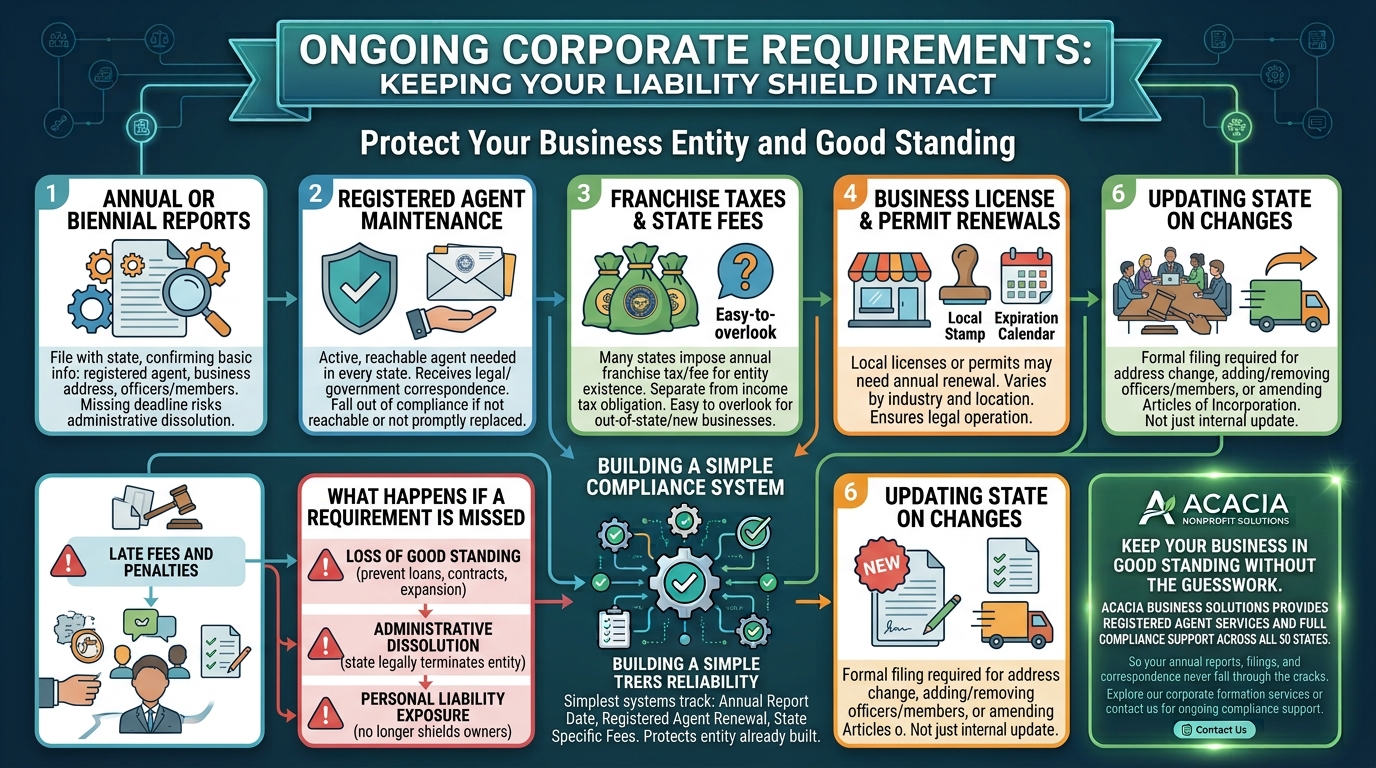
- Annual or Biennial Reports
Most states require corporations and LLCs to file a report, sometimes annually and sometimes every
other year, confirming basic information such as the registered agent, business address, and officers or
members. Missing the deadline can start the clock toward administrative dissolution in many states. - Registered Agent Maintenance
Every state requires an active, reachable registered agent to accept legal and government
correspondence on the business’s behalf. If a registered agent resigns or becomes unreachable and is
not replaced promptly, a business can fall out of compliance without the owner realizing a deadline was
missed. - Franchise Taxes and State Fees
Many states impose an annual franchise tax or fee for maintaining an entity’s existence, separate from
any income tax obligation. These fees are easy to overlook, particularly for out-of-state or newly formed
businesses. - Business License and Permit Renewals
Depending on industry and location, a business may need to renew local licenses or permits annually to
legally continue operating. - Maintaining Corporate Formalities
Ongoing corporate requirements overview
Corporations must hold regular board and shareholder meetings. They must keep minutes and document major decisions.
LLCs have more flexibility, but an operating agreement that is followed remains important for liability protection.
If a business changes its address, it must file changes with the state. If it adds or removes officers or members, or amends its Articles of Incorporation, most states require a formal filing.
What happens if a requirement is missed? Consequences vary by state but typically escalate in the following order.
Compliance with ongoing corporate requirements helps avoid penalties.
- Late fees and penalties
- Loss of good standing status, which can prevent a business from securing loans, signing contracts,
or expanding into new states - Administrative dissolution, where the state legally terminates the business entity
- Personal liability exposure, since a dissolved entity no longer shields owners the way an active one
does
Building a Simple Compliance System
Businesses that never miss a deadline are rarely the ones with the most resources. They are the ones
with the simplest systems. A basic compliance calendar tracking the annual report date, registered agent
renewal, and any state specific fees goes a long way toward protecting the entity that has already been
built.
Keep your business in good standing without the guesswork. Acacia Business Solutions provides
registered agent services and full compliance support across all 50 states, so your annual reports, filings,
and correspondence never fall through the cracks. Explore our corporate formation services or contact
us to set up ongoing compliance support today.
Expand your knowledge of asset protection, business planning, taxation, and private trusts. Explore the available books on Amazon.