

The Ultimate Guide to How Checkbook IRAs Really Work
A Checkbook IRA guide explains the direct control investors gain over retirement funds that a traditional IRA lacks. Additionally, understanding how this structure works and how it differs from a standard self-directed IRA helps you decide.
What Is a Checkbook IRA?
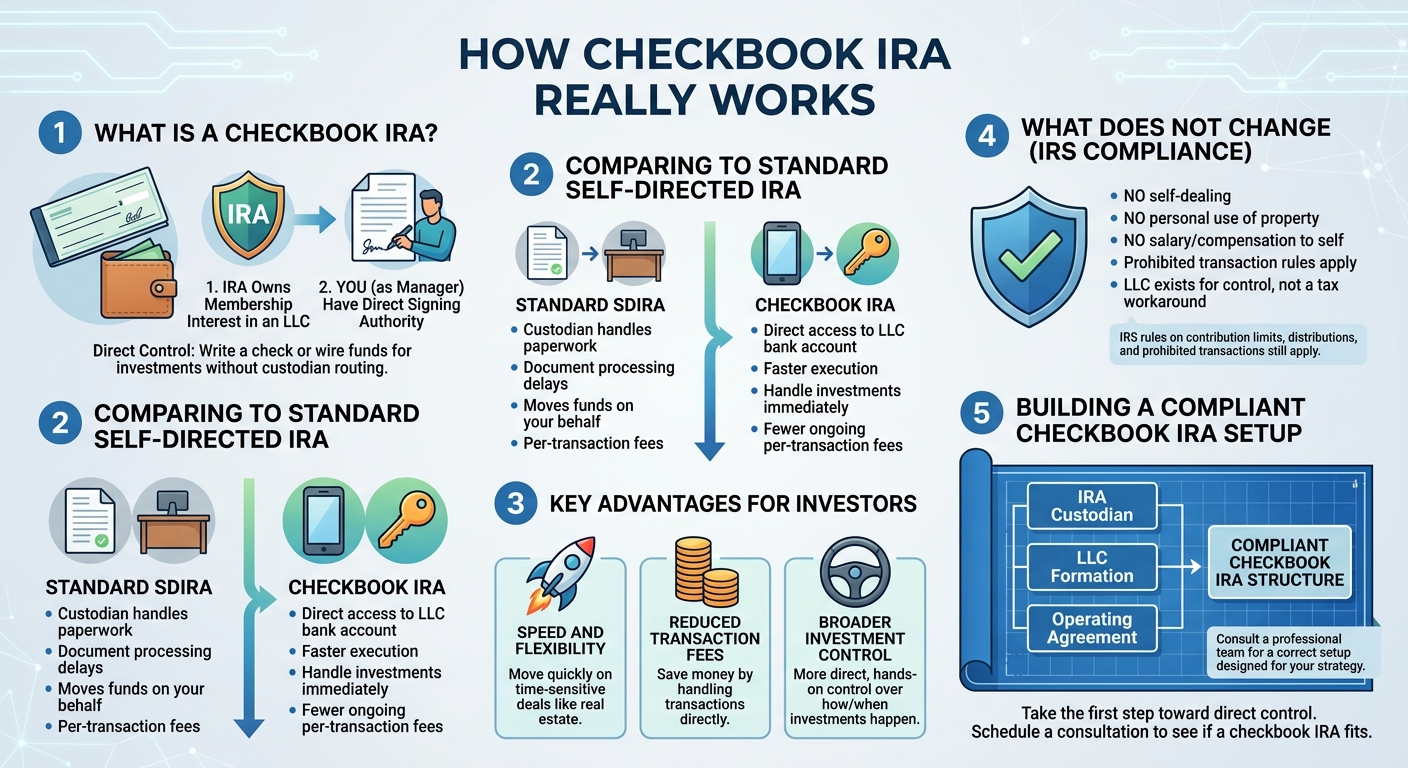
A checkbook IRA, sometimes called a checkbook control IRA, combines a self-directed IRA with a specially structured LLC. Instead of directing a custodian to make each investment for you, the IRA owns a membership interest in an LLC. This Checkbook IRA guide helps explain the setup.
You, as the LLC manager, have direct signing authority over the LLC’s bank account. You can write a check to make an investment without routing every transaction through a custodian. You can also wire funds directly for an investment.
How It Differs From a Standard Self Directed IRA
A standard self directed IRA already allows for a broader range of investments than a typical brokerage IRA. Moreover, it includes real estate, private companies, and other alternative assets, per the Checkbook IRA guide.
However, every transaction still goes through the custodian, who processes paperwork and moves funds for the account holder.
This can slow down time sensitive investments and often comes with per transaction fees.
A checkbook IRA removes that bottleneck. Once the LLC is set up and funded by the IRA, the account holder can move quickly on investment opportunities, paying for a property, funding a private loan, or making another qualifying investment directly from the LLC’s account, without waiting on custodian approval for each transaction.
Why Investors Choose This Structure
Speed and flexibility. Time sensitive deals, such as competitive real estate purchases, often require the ability to move quickly. A checkbook IRA allows funds to move as fast as the investor can act.
Reduced transaction fees. Because the account holder handles transactions directly rather than routing each one through a custodian, many checkbook IRA structures reduce the ongoing per transaction fees associated with a standard self directed IRA.
Broader investment control. While the IRA still must invest in assets permitted under IRS rules, the checkbook structure gives the account holder more direct, hands on control over how and when those investments happen.
What a Checkbook IRA Does Not Change
A checkbook IRA does not change the underlying tax rules that govern IRAs. Contribution limits, distribution rules, and prohibited transaction rules all still apply. The LLC exists to provide operational control, not to create a workaround for IRA regulations. Investors considering this structure need to understand these rules clearly, since violating them can jeopardize the tax advantaged status of the entire IRA.
Is a Checkbook IRA Right for You?
A checkbook IRA tends to make the most sense for investors who plan to make frequent alternative investments, particularly in real estate, and who want to avoid the delays and fees that come with routing every transaction through a custodian. Investors who plan to make few transactions, or who are not comfortable with the added responsibility of managing an LLC, may be better served by a standard self directed IRA.
Let Acacia Business Solutions Set Up Your Checkbook IRA
Setting up a checkbook IRA correctly requires careful coordination between the IRA custodian, the LLC formation, and the operating agreement governing the structure. Acacia Business Solutions helps investors set up compliant checkbook IRA structures designed to work the way they are supposed to.
Explore our IRA services to learn more about getting started. Visit Acacia Business Solutions to schedule a consultation and see if a checkbook IRA fits your investment strategy.
Expand your knowledge of asset protection, business planning, taxation, and private trusts. Explore the available books on Amazon.