

When to Use a DBA: Scenarios, Benefits, and Alternatives
Introduction
A DBA is one of the least expensive tools in business formation, which is exactly why owners sometimes file one without asking whether they need it, or skip one when they do. The right answer depends on your legal structure, your branding plans, and how you intend to bank and market the business.
This guide walks through the situations where a DBA makes sense, the situations where it doesn’t, and the alternatives worth weighing. If you’re still getting oriented, start with our overview of What a DBA is
The Core Rule: Operating Under a Name That Isn’t Your Legal Name
The general principle is simple: if you do business under any name other than your exact legal name, most jurisdictions expect you to register that name. Where the exact requirements differ, the principle holds.
Here is how that plays out for each type of business.
Sole proprietors
A sole proprietor’s legal name is their personal name. If Maria Lopez offers bookkeeping services as “Maria Lopez,” she typically doesn’t need a DBA. If she calls the business “Clear Ledger Bookkeeping,” she typically does. Sole proprietors are the most common DBA filers, since they have no entity name to fall back on.
General partnerships
A general partnership’s legal name is usually the partners’ names or a name stated in the partnership agreement. Operating under a brand name generally requires a DBA, and often the registration lists all partners.
LLCs and corporations
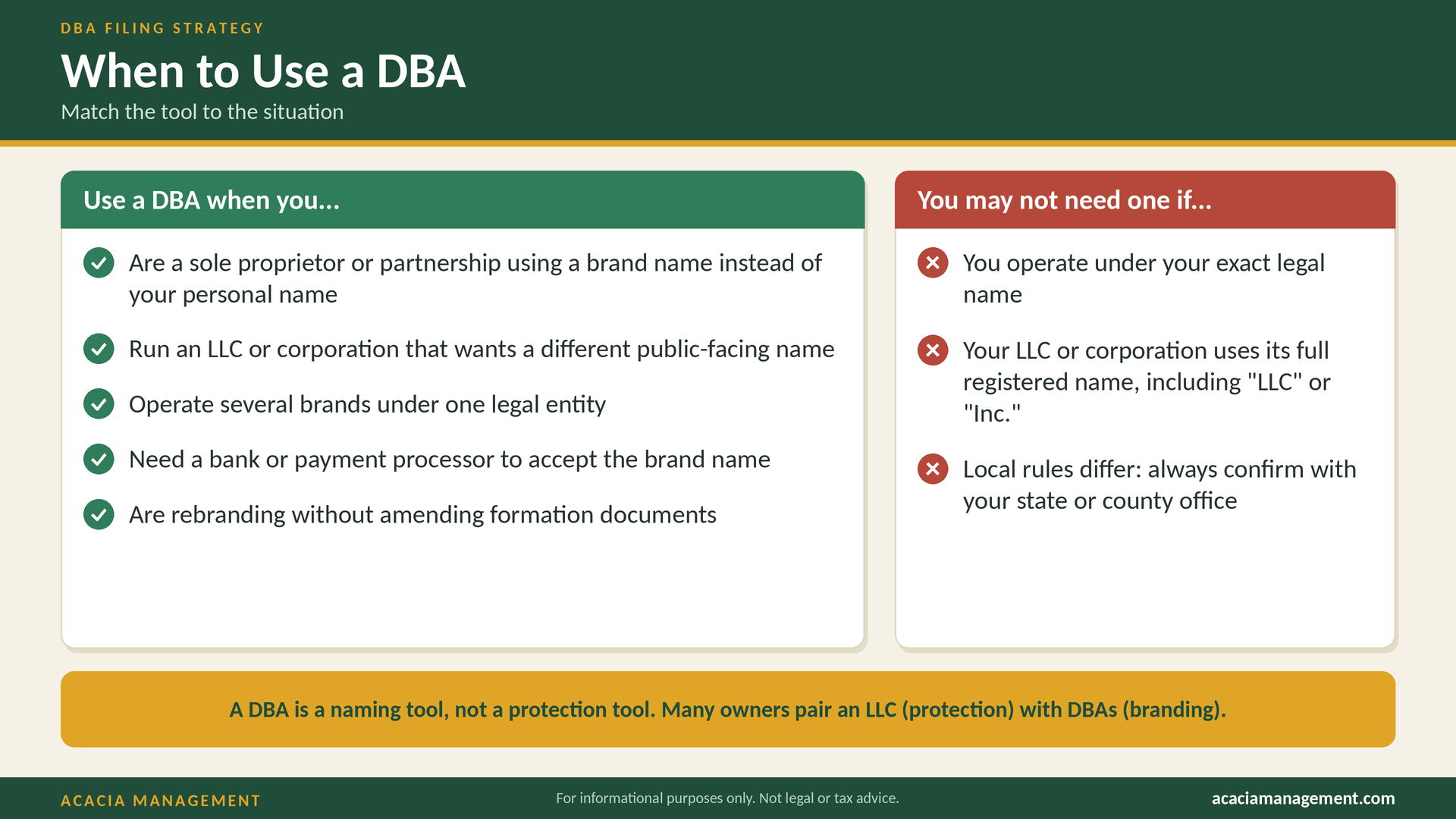
An LLC or corporation operating under the exact name on its formation documents (including “LLC,” “Inc.,” or similar designators) generally doesn’t need a DBA. But if it drops the designator in marketing or uses a completely different brand, a DBA is usually required.
Seven Situations Where a DBA Makes Sense
1. You want a brand name, not your personal name
A memorable brand is easier to market than a personal name. A DBA lets a freelancer, consultant, or contractor build a recognizable identity while remaining a sole proprietor.
2. Your LLC or corporation wants a different public-facing name
Legal names are often chosen for availability or family reasons, not marketing appeal. A DBA lets you present a more customer-friendly name without amending your formation documents.
3. You operate multiple brands under one entity
A restaurant group might run a pizzeria, a bakery, and a catering arm under one LLC. Filing a DBA for each concept is faster and cheaper than forming three companies. Just remember all three share one liability structure, so if risk levels differ widely, separate entities may be wiser.
4. You’re launching a new product line or service
A DBA can test a new offering with separate branding before you commit to restructuring.
5. You need to open a bank account or accept payments in the brand’s name
Banks and payment processors usually ask for a DBA certificate when the account name differs from the owner’s legal name. Without one, customers may hesitate to write checks to an unfamiliar name.
6. You’re rebranding
If a business changes its public name, filing a DBA is often simpler than formally amending the entity’s name, particularly when contracts, licenses, and registrations are tied to the legal name.
7. You’ve acquired a business and want to keep its name
When you buy an existing business, you may want to keep operating under the well-known name. A DBA can preserve that goodwill (confirm what you actually acquired in the purchase agreement, as the right to use a name is a separate question from registering it).
Situations Where a DBA May Not Be Needed
- You use your exact legal name. A sole proprietor named Jane Smith doing business as “Jane Smith” usually doesn’t need to register.
- Your LLC or corporation uses its full registered name. Using “Harbor Ventures, LLC” exactly as formed generally requires no DBA.
- You’re a hobbyist or you aren’t engaged in business activity. Rules vary, but selling occasionally without a brand name may not trigger a registration requirement. Once you advertise a trade name or operate regularly, that changes.
Because rules differ by state and sometimes by county or city, confirm requirements with your local filing office.
Benefits of Using a DBA
- Low cost. Filing fees are typically modest compared with forming an entity, though publication requirements in some areas add cost.
- Speed and simplicity. Many DBAs can be filed online or by mail within days or weeks.
- Flexibility. You can add or retire brands as the business evolves.
- Professional image. A brand name often reads as more established than a personal name.
- Banking access. A DBA certificate supports business banking in the brand’s name.
Limitations to Weigh Before You File
- No liability protection. A sole proprietor with a DBA remains personally liable.
- No exclusive name rights. Others can use similar names unless you secure a trademark.
- Ongoing compliance. Some jurisdictions require renewal and updates when information changes.
- Shared liability across brands. Under one entity, a claim against one brand can reach the others.
DBA vs. Forming a New Entity
Ask these questions to decide whether a DBA alone is enough or whether you need an LLC or corporation.
- How much personal risk does the business carry? Contractors, food service, and anything involving physical risk or large contracts often warrant liability protection.
- Do you have employees or plan to hire? Employees introduce additional exposure.
- Will you seek financing or investors? Lenders and investors typically prefer a formal entity.
- Do you have partners? An entity with a written operating agreement offers clarity that a general partnership may not.
- Do you want to separate brands for risk reasons? Separate LLCs can wall off liabilities, while multiple DBAs under one LLC cannot.
If you answered yes to several, a DBA alone likely isn’t enough. Many owners form an LLC and then add DBAs as needed.
Alternatives to a DBA
- Amend your entity’s legal name. If you want the brand name to be your legal name, you can file an amendment. This changes the formal record rather than adding a second name.
- Form a new entity with the brand name. Appropriate when you want separate liability or ownership for the brand.
- Register a trademark. Provides much stronger brand protection, though it doesn’t replace a DBA where one is required.
- Use your legal name only. The simplest approach if branding isn’t a priority.
Key Takeaways
- Use a DBA when you operate under a name other than your exact legal name.
- Sole proprietors, partnerships, and entities with separate brand names are the most common filers.
- A DBA is cheap and flexible, but it offers no liability protection or exclusive name rights.
- Often the best structure combines an LLC (for protection) with DBAs (for branding).
This article is for informational purposes only and does not constitute legal or tax advice.
Expand your knowledge of asset protection, business planning, taxation, and private trusts. Explore the available books on Amazon.