

Strategic Structuring Advisory: Aligning Your Business Structure With Your Goals
Most business owners spend months perfecting a product and minutes choosing a legal structure. Yet structure determines how much tax you pay, how exposed your personal assets are, how easily you can bring in partners or investors, and how smoothly you can grow or exit.
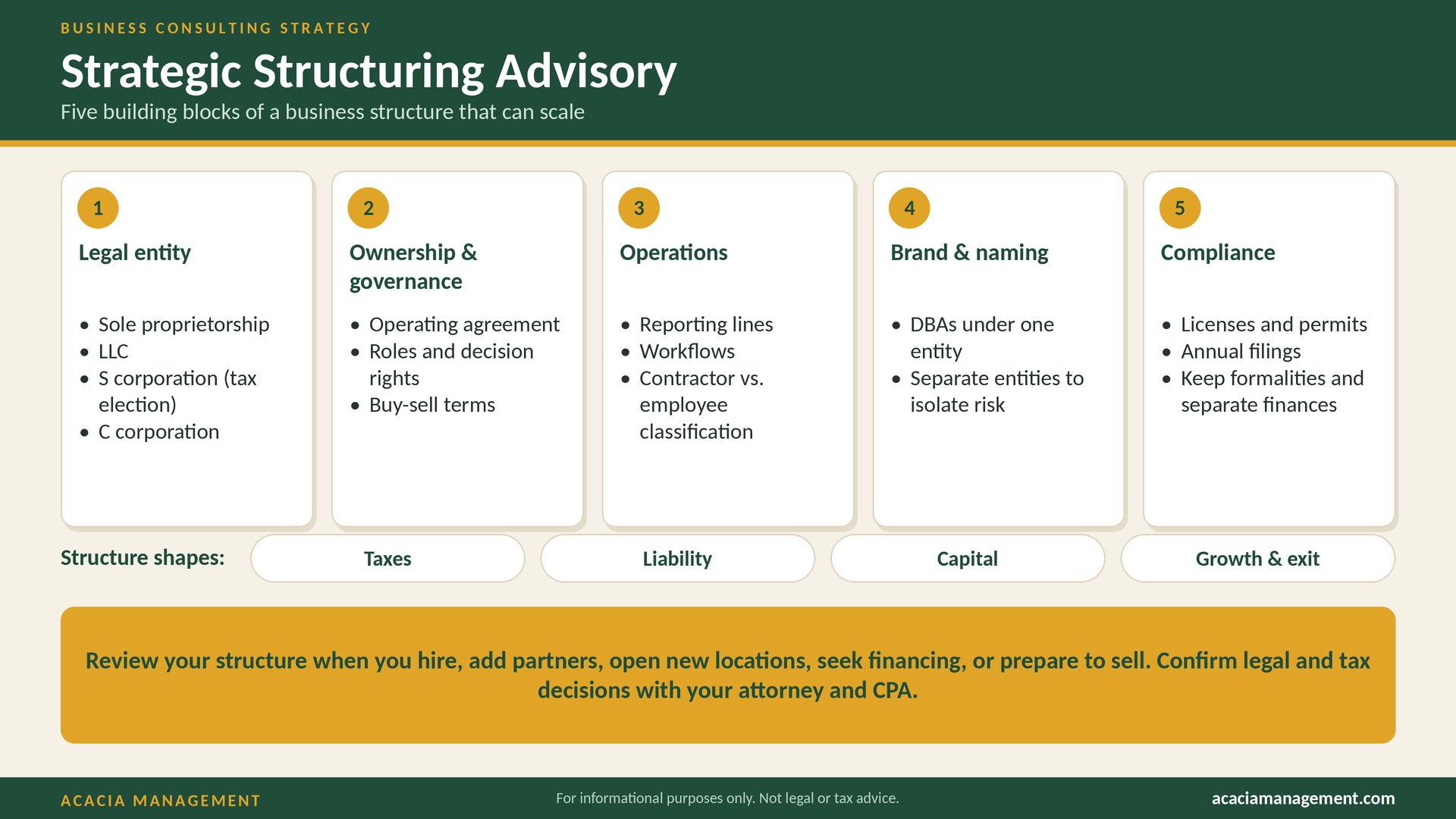
Strategic structuring advisory is a consulting service that looks at those decisions together, in light of where you want the business to go, rather than treating each as an isolated form to file. This guide explains what it covers, why it matters, and when to seek it.
What Is Strategic Structuring Advisory?
Strategic structuring advisory is a planning-focused engagement in which an advisor reviews your business’s legal, ownership, operational, and compliance framework and recommends a structure aligned with your goals. It is distinct from simply forming an entity. Formation is a transaction, while structuring is a strategy.
A good structuring review asks questions such as:
- What are you trying to achieve in the next one, three, and five years?
- Where does your business face the most risk?
- Who owns what, and who makes which decisions?
- How will profits be distributed and taxed?
- Will you need outside capital, or plan a sale or succession?
- Does your current setup support those plans, or work against them?
The Core Components of Business Structure
1. Legal entity selection
The entity type is the foundation. The most common options in the U.S. are:
- Sole proprietorship. Simple and inexpensive, but no separation between owner and business, so liability is personal.
- General partnership. Two or more owners sharing profits and liability by default.
- Limited liability company (LLC). Offers liability protection and flexible taxation. By default, a single-member LLC is taxed like a sole proprietorship and a multi-member LLC like a partnership, but an LLC can elect to be taxed as a corporation.
- S corporation. Not a legal entity type but a tax election available to eligible LLCs and corporations. Profits pass through to owners, and in some cases owners can reduce self-employment tax exposure through reasonable salary and distributions. There are eligibility limits, including a cap on the number of shareholders and restrictions on who may own shares.
- C corporation. A separate taxpayer, often preferred when seeking venture capital or planning to issue multiple classes of stock. Profits can be taxed at the corporate level and again when distributed as dividends.
No option is best for everyone. The right choice depends on your income level, growth plans, number of owners, industry risk, and state laws.
2. Ownership and governance
Who owns what is just as important as what the entity is. Key documents include:
- Operating agreement (LLC) or bylaws and shareholder agreement (corporation). These set voting rights, profit splits, management roles, and rules for adding or removing owners.
- Buy-sell provisions. These determine what happens if an owner dies, becomes disabled, divorces, or wants out.
- Capital contribution and equity terms. These record who invested what and what they receive in return.
Many partner disputes trace back to the absence of clear written agreements. Putting terms on paper while relationships are good prevents costly conflict later.
3. Operational structure
Operational structure covers how work gets done:
- Reporting lines and decision rights
- Roles, responsibilities, and accountability
- How locations, departments, or divisions are organized
- Workflows and internal controls
- Contractor vs. employee classification, which carries tax and legal consequences when misapplied
A business may be well-structured on paper and still struggle because operations were never designed to scale.
4. Brand and naming strategy
How you present your business affects structure too. A single entity can operate multiple brands using DBAs, while separate entities can isolate risk across brands. Learn the basics in our DBA Filing Strategy cluster and see when to use a DBA
5. Compliance foundation
Structure creates ongoing obligations:
- Annual reports and franchise or registered-agent fees
- Business licenses and permits
- Tax filings and payroll compliance
- Record-keeping and corporate formalities that preserve liability protection
- Industry-specific regulations
Failing to follow formalities can allow a court to disregard your entity’s liability protection in some cases, a risk often described as “piercing the corporate veil.”
Why Structure Matters
Taxes
Entity type and tax elections affect how income is taxed, how owners are paid, and what deductions are available. The difference between structures can be significant, though the best choice depends on your specifics. This is where your CPA’s input is essential.
Liability
A properly formed and maintained entity can shield personal assets from business debts and lawsuits, with exceptions such as personal guarantees and your own wrongdoing. Insurance remains important in every structure.
Capital and growth
Investors and lenders usually want a clean structure, clear ownership records, and organized documentation. A messy cap table or missing agreements can slow or kill a financing round.
Succession and exit
Whether you plan to sell, pass the business to family, or step back, structure affects valuation, tax treatment, and how smooth the transition is.
Structure Should Evolve
A setup that suits a solo founder can become a liability once you hire, add partners, open locations, or sign larger contracts. Triggers for reviewing your structure include:
- Hiring your first employees
- Reaching a new income level
- Adding or removing owners
- Opening a new location or entering a new state
- Launching a high-risk product or service
- Seeking a loan or investment
- Preparing for sale or succession
- Changes in tax law
Reviewing at least annually, and at each trigger, keeps your structure aligned with the business you’ve become.
What a Structuring Advisory Engagement Looks Like
- Discovery. The advisor learns your goals, history, financials, and concerns.
- Assessment. Existing entities, agreements, licenses, and processes are reviewed for gaps and risks.
- Options analysis. You receive structure alternatives with trade-offs in cost, tax, liability, and complexity.
- Recommendation and roadmap. A prioritized action plan with timelines and responsibilities.
- Implementation support. Coordination with your attorney and CPA to execute filings, agreements, and registrations.
- Ongoing review. Scheduled check-ins to adapt as the business grows.
A Note About Professional Advice
A structuring advisor helps you see options and make informed decisions. Legal documents should be drafted or reviewed by an attorney, and tax elections should be confirmed with a CPA or tax professional. A good advisor coordinates with them rather than replacing them.
Common Structuring Mistakes
- Choosing an entity based only on the lowest filing fee
- Operating as a sole proprietor long after liability risk has grown
- Having multiple owners without a written agreement
- Mixing personal and business finances, which undermines liability protection
- Ignoring annual compliance filings
- Forming entities in a different state without understanding the added cost and registration requirements
- Never revisiting the structure as the business changes
Key Takeaways
- Structure affects taxes, liability, funding, and the ability to grow or exit.
- Strategic structuring looks at entity, ownership, operations, branding, and compliance together.
- Review your structure at key milestones, not just at formation.
- Coordinate with your attorney and CPA for legal and tax decisions.
This article is for informational purposes only and does not constitute legal or tax advice.
Expand your knowledge of asset protection, business planning, taxation, and private trusts. Explore the available books on Amazon.