

The Role of Consulting: How a Business Consultant Adds Value
Running a business means wearing every hat at once, so there’s rarely time to step back and look at the whole picture. That’s where a business consultant comes in. A consultant brings specialized experience, an outside perspective, and the dedicated time that owners often can’t spare.
This article explains what business consultants do, what they don’t do, when bringing one in makes sense, and how to choose and work with one effectively.
What Is a Business Consultant?
A business consultant is a professional who advises owners and leadership teams on how to improve their business. Consultants may specialize in strategy, operations, finance, marketing, human resources, technology, compliance, or business structure, or they may work across several areas for small and mid-sized companies.
Consultants differ from employees in that they’re engaged for a defined scope and time period, and from freelancers in that their value lies mainly in analysis, advice, and planning rather than in executing day-to-day tasks.
What Does a Business Consultant Actually Do?
Diagnose
A consultant examines your structure, processes, finances, and compliance to find gaps, inefficiencies, and risks. Because they aren’t embedded in daily operations, they often see what insiders miss.
Advise
Rather than hand you a single answer, a good consultant lays out options with trade-offs: cost, risk, timing, and effort. For example, they might compare staying a sole proprietor with forming an LLC, or opening a second location with building an online channel.
Plan
Consultants turn goals into a roadmap with priorities, milestones, owners, and deadlines, so that intentions become actions.
Coordinate
Consultants often work alongside your attorney, CPA, insurance agent, and banker, helping translate business goals into the right professional tasks and keeping everyone aligned.
Support implementation
Some engagements stop at recommendations, while others include help carrying them out, such as setting up systems, preparing filings, or training staff.
Hold you accountable
Regular check-ins keep priorities on track. This accountability role is often undervalued, but it’s where many plans succeed or fail.
What a Consultant Does Not Do
Setting realistic expectations avoids disappointment.
- Legal advice. Unless they are also licensed attorneys acting in that capacity, consultants don’t provide legal advice or draft legally binding documents. Contracts, entity formation documents, and legal opinions should come from attorneys.
- Tax advice and filings. Tax planning and returns belong with CPAs or enrolled agents.
- Guaranteed results. Honest consultants don’t promise specific revenue or growth outcomes.
- Running your business for you. Consultants guide decisions, and owners remain responsible for them.
A trustworthy consultant will tell you where their scope ends and when to bring in another professional.
Consultant vs. Other Advisors
| Advisor | Primary focus |
|---|---|
| Business consultant | Strategy, structure, operations, planning |
| Attorney | Legal rights, contracts, entity formation, liability |
| CPA / tax professional | Accounting, tax planning, tax filings |
| Financial advisor | Personal or business investments and financial planning |
| Insurance agent | Risk transfer through policies |
| Coach / mentor | Personal development and accountability |
The best results often come from these professionals working together, with the consultant serving as the strategic coordinator.
When to Bring in a Consultant
Consulting delivers the most value at decision points. Consider one when you are:
- Launching a business and want to set it up correctly from the start
- Hiring your first employees and need roles, policies, and compliance in place
- Adding partners or investors and need clear ownership and governance
- Expanding to new locations, markets, or product lines
- Preparing for financing and need organized documentation and projections
- Planning for sale or succession
- Facing a plateau or feeling overwhelmed by complexity
- Reorganizing after a setback such as a dispute, loss of a key client, or compliance issue
- Unsure whether your structure still fits the business you’ve built
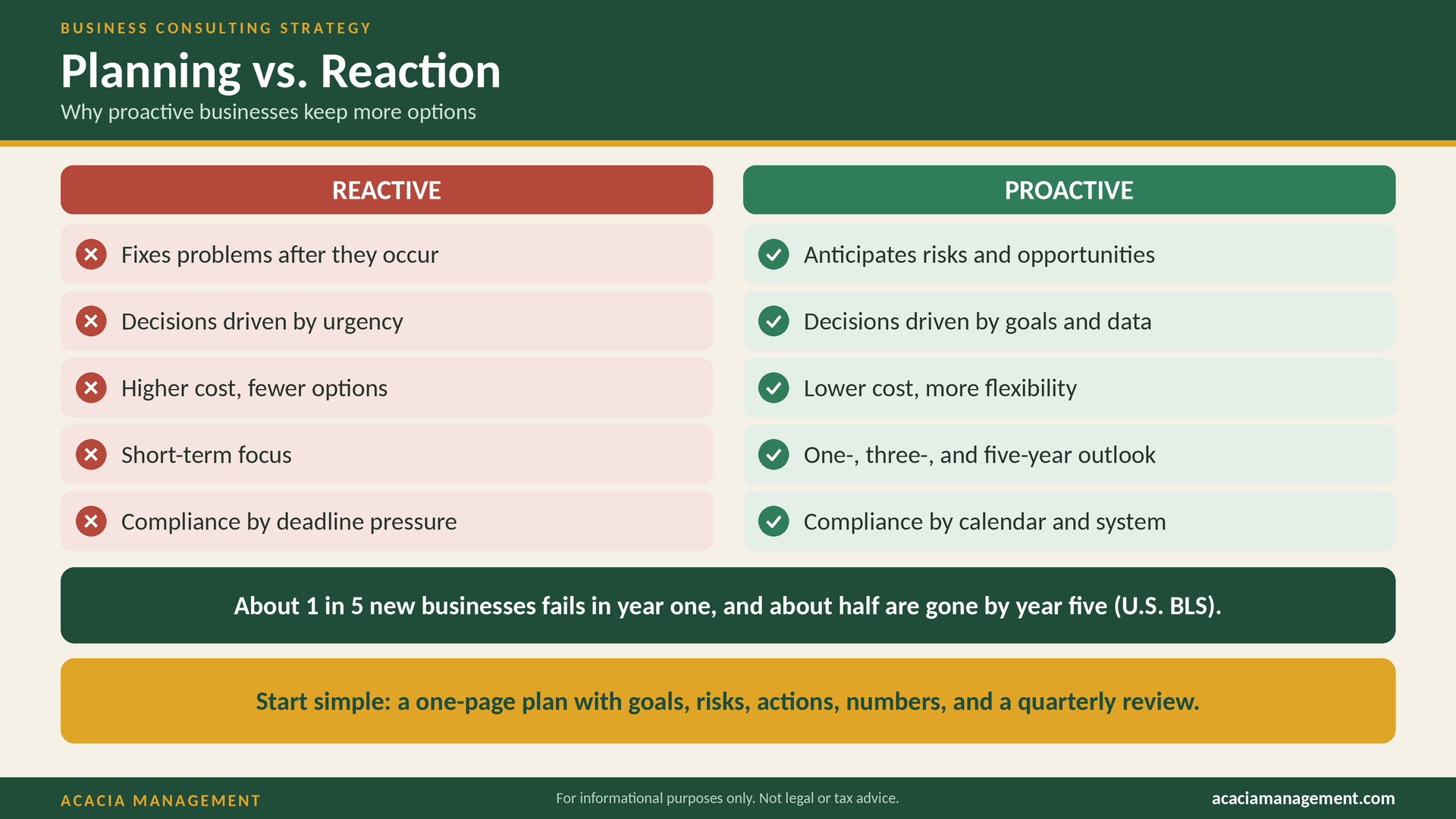
Don’t wait for a crisis. As discussed in [Planning vs. Reaction: Internal link: /blog/planning-vs-reaction], earlier engagement typically costs less and offers more options.
Benefits of Working With a Consultant
- Objectivity. An outsider can challenge assumptions without politics or emotion.
- Expertise. You gain experience from many businesses without hiring full-time staff.
- Speed. Proven frameworks and templates shorten the learning curve.
- Focus. Dedicated time on strategic issues you’d otherwise postpone.
- Risk reduction. Problems get identified before they become expensive.
- Accountability. Regular progress reviews keep momentum.
How Consultants Charge
Pricing models vary, and you should understand them before signing.
- Hourly. Flexible for small or uncertain scopes, but total cost can be hard to predict.
- Fixed project fee. Defined scope and price, which is good for assessments or specific deliverables.
- Monthly retainer. Ongoing access and support at a predictable cost.
- Performance-based. Part of the fee depends on results. This is less common and needs careful definition of measures.
Ask what’s included, what’s extra, and how changes in scope are handled.
How to Choose the Right Consultant
- Relevant experience. Look for experience with businesses of your size, industry, or stage.
- Clear scope and deliverables. You should know exactly what you’ll receive and when.
- Transparent pricing. Avoid vague estimates and surprise charges.
- References and track record. Ask to speak with past clients.
- Communication style. You’ll work closely, so clarity and fit matter.
- Respect for professional boundaries. Look for someone who coordinates with your attorney and CPA and doesn’t overreach.
- Customization. Be cautious of one-size-fits-all templates.
Red flags
- Guarantees of specific financial results
- Pressure to sign immediately
- Unwillingness to put the scope and fees in writing
- Claims to replace your attorney or CPA
- No references or verifiable experience
How to Get the Most From a Consulting Engagement
- Define goals up front. Know what success looks like.
- Share honest information. Consultants can only solve what they can see.
- Assign an internal point person so decisions don’t stall.
- Commit time. Implementation requires effort on your side.
- Review progress regularly and adjust the plan as needed.
- Document what’s learned so the benefits outlast the engagement.
Consulting and Structure: A Natural Fit
Structure is one of the most common reasons owners seek consulting, since it touches taxes, liability, funding, and growth at once. Consultants help owners weigh entity options, clarify ownership, organize compliance, and decide whether tools like DBAs are appropriate. See Strategic Structuring Advisory and our DBA Filing Strategy guides
Key Takeaways
- Consultants diagnose, advise, plan, coordinate, and hold you accountable.
- They complement, not replace, your attorney and CPA.
- Engage one at decision points such as launching, hiring, expanding, or preparing for financing.
- Choose based on experience, clear scope, transparent pricing, and references.
Next Steps
Ready to talk through your goals? Book a consultation with Acacia Management or view our consulting services. For additional resources, see the SBA’s local assistance programs at https://www.sba.gov
Expand your knowledge of asset protection, business planning, taxation, and private trusts. Explore the available books on Amazon.