

Planning vs. Reaction: Why Proactive Businesses Win
Every business faces surprises: a key employee leaves, a client stops paying, a regulation changes, a lawsuit lands. What separates resilient companies from fragile ones is rarely luck. It’s whether they had a plan, and options, before the surprise arrived.
This article compares reactive and proactive approaches to running a business, explains why planning is usually less expensive than recovery, and offers a practical way to start, even if you’re too busy for a formal strategic plan.
What Does It Mean to Be Reactive?
A reactive business makes major decisions in response to events:
- Forming an LLC after being sued as a sole proprietor
- Addressing tax problems after receiving a notice
- Writing a partnership agreement after a dispute starts
- Looking for funding after cash runs out
- Updating compliance after a missed deadline triggers penalties
Reaction isn’t always a failure of effort. Owners are busy, and urgent tasks crowd out important ones. But the pattern has predictable costs.
The hidden costs of reacting
- Higher direct costs. Emergency legal help, penalties, and rushed fixes usually cost more than planned work.
- Fewer options. Some protections can’t be added after the fact. Insurance may not cover events that already occurred, and transferring assets into an entity after a claim arises can be challenged by creditors.
- Rushed decisions. Urgency narrows your thinking, and you pick the first workable solution rather than the best one.
- Lost time and focus. Crisis management pulls attention away from growth.
- Damaged relationships. Disputes with partners, customers, or regulators can leave lasting harm.
What Does It Mean to Be Proactive?
A proactive business anticipates risks and opportunities and decides how to handle them in advance. It sets goals, reviews structure regularly, tracks the numbers, and builds buffers.
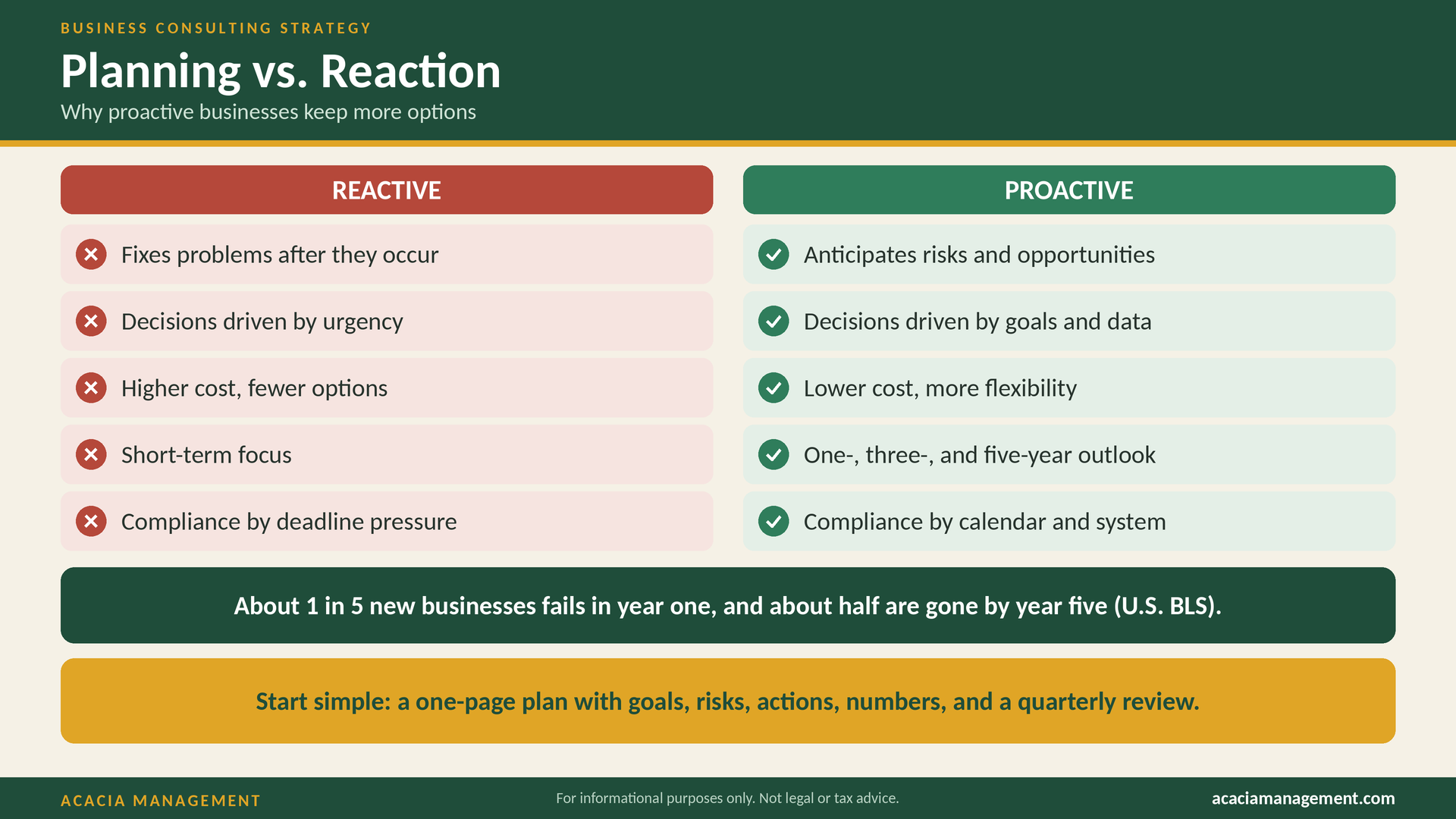
| Reactive | Proactive |
|---|---|
| Fixes problems after they occur | Anticipates risks and opportunities |
| Decisions driven by urgency | Decisions driven by goals and data |
| Higher cost, fewer options | Lower cost, more flexibility |
| Short-term focus | One-, three-, and five-year outlook |
| Compliance by deadline pressure | Compliance by calendar and system |
| Relies on memory and the owner | Relies on documented processes |
Why Planning Matters: What the Data Suggest
According to U.S. Bureau of Labor Statistics business employment dynamics data, roughly one in five new businesses fails within the first year, and about half no longer operate after five years. Causes vary and include market conditions, competition, and funding. Surveys of failed businesses frequently cite running out of cash and lack of planning among the contributing factors.
Planning doesn’t guarantee success, but it improves your ability to see problems coming and respond calmly.
Seven Areas Where Planning Pays Off
1. Business structure
Choosing and updating your entity type, ownership terms, and tax elections before you need them keeps your protection and flexibility intact. See Strategic Structuring Advisory
2. Cash flow and finances
A simple 12-month forecast, a cash reserve, and regular reviews of margins and receivables can reveal shortfalls months in advance. Separate personal and business finances from day one.
3. Risk management
Map the risks that could hurt you most: liability claims, key-person dependence, cyber incidents, customer concentration, and supplier failure. Then decide what to do about each, whether through insurance, contracts, diversification, or process changes.
4. Compliance
Create a compliance calendar for annual reports, license renewals, DBA renewals, tax deadlines, and payroll filings. See our [DBA compliance requirements guide: Internal link: /blog/dba-compliance-requirements] for an example of how deadlines add up.
5. People and succession
Document roles, cross-train key tasks, and decide what happens if you or a key partner is unavailable. Even small businesses benefit from a basic continuity plan.
6. Growth
Plan hiring, locations, and new offerings against cash and capacity, not just ambition. Growing faster than your systems or funding can support is a common cause of trouble.
7. Exit
Whether you intend to sell in ten years or never, building a business that can run without you increases its value and its resilience.
Planning Doesn’t Have to Be Complicated
Many owners avoid planning because they imagine a 40-page document. A useful plan can fit on one page:
- Goals. Three to five measurable targets for the next 12 months.
- Risks. The top five things that could derail you.
- Actions. The next steps, who owns them, and when they’re due.
- Numbers. Revenue, margin, and cash targets, plus a short list of metrics to watch.
- Review date. A quarterly check-in on the calendar.
A one-page plan reviewed regularly beats a detailed plan that sits in a drawer.
How to Shift From Reactive to Proactive
- Audit what you have. Gather formation documents, agreements, licenses, insurance policies, and financial statements. Note anything missing or out of date.
- List your biggest exposures. Where would a surprise hurt most?
- Prioritize. Tackle high-impact, low-effort items first, such as setting up a compliance calendar or signing a missing agreement.
- Schedule reviews. Put quarterly planning sessions and an annual structure review on the calendar.
- Bring in outside perspective. A consultant or advisory team can spot blind spots and keep you accountable. See The Role of Consulting.
- Document and delegate. Write down processes so the business doesn’t depend on your memory.
Key Takeaways
- Reactive decisions tend to cost more, offer fewer options, and distract from growth.
- Proactive planning anticipates risks and opportunities and builds flexibility.
- A simple, regularly reviewed plan is better than none.
- Review structure, finances, compliance, and risk on a schedule, not just in a crisis.
Next Steps
Start with a one-page plan this week. If you’d like help building a roadmap, contact Acacia Management or explore our business consulting services. For more on structure, read Strategic Structuring Advisory and for statistics on business survival, see the U.S. Bureau of Labor Statistics at bls.gov
This article is for informational purposes only and does not constitute legal, tax, or financial advice.
Expand your knowledge of asset protection, business planning, taxation, and private trusts. Explore the available books on Amazon.